
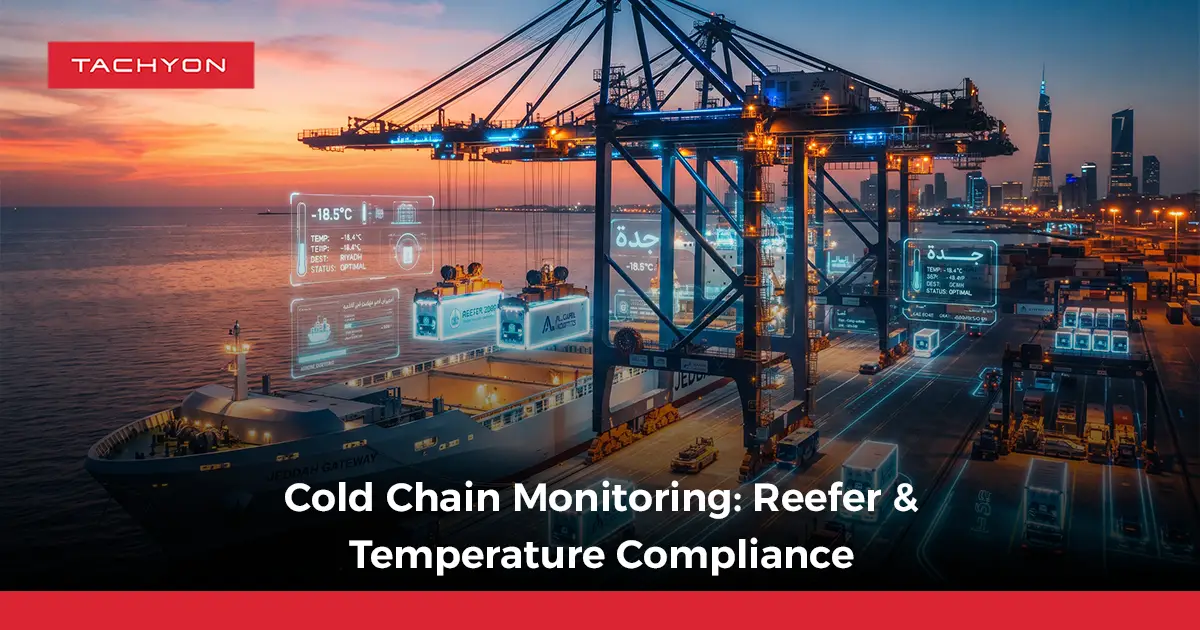
Cold chain monitoring tracks the conditions surrounding temperature-sensitive products while they move through storage, transportation, and delivery.
The goal is not simply to record a temperature number. Effective monitoring should show whether the product remained within its required conditions, where an excursion happened, how long it lasted, and whether operations can still intervene before product quality is affected.
Key Takeaways
- Cold chain monitoring covers more than temperature: Location, humidity, time, route progress, and equipment status may also affect product condition.
- Product limits should drive monitoring rules: There is no single temperature range that applies to every cold-chain shipment.
- Real-time monitoring changes the response window: Teams can investigate an excursion while a shipment is still moving instead of discovering it only after delivery.
- Storage and transport must stay connected: Monitoring should continue across warehouses, loading, transportation, and receiving points.
- Temperature excursions need context: The severity of an excursion depends on temperature, duration, product requirements, and applicable quality procedures.
- Saudi compliance matters: Food and pharmaceutical cold chains operate under SFDA requirements and product-specific transport and storage controls.
- Historical monitoring data has operational value: Excursion patterns can expose weak routes, facilities, vehicles, or processes that need improvement.
What Does Cold Chain Monitoring Actually Track?
- Temperature: Confirms whether products remain within defined operating or storage limits.
- Humidity: Important where product quality can be affected by environmental moisture.
- Location: Shows where the shipment was when an excursion or delay occurred.
- Time: Records how long the shipment or product remained under particular conditions.
- Vehicle or Container Status: Helps operations understand the transport environment around the shipment.
- Shipment Milestones: Links environmental conditions with loading, departure, arrival, unloading, and delivery events.
- Alerts: Notify responsible teams when predefined limits or conditions are breached.
- Historical Records: Preserve evidence for quality review, investigations, audits, and operational analysis.
WHO specifically provides technical guidance for temperature and humidity monitoring in both fixed storage areas and transport operations, demonstrating why cold-chain control must extend across the complete logistics environment rather than transportation alone.
Why Do Cold Chain Problems Happen Between Storage and Delivery?
1. Products Move Between Different Environments
A shipment can leave a controlled warehouse, wait at a loading area, enter a refrigerated vehicle, stop at another facility, and finally reach the customer.
Every handoff introduces another point where environmental conditions can change.
2. Refrigeration Performance Can Change
Opening doors, loading warm goods, equipment problems, incorrect settings, or frequent unloading can affect the internal environment of a refrigerated vehicle.
3. Delays Extend Exposure Time
Traffic, loading delays, failed delivery attempts, or long waiting times increase the amount of time a temperature-sensitive product remains in transit.
4. Monitoring Can Become Fragmented
Warehouse teams may keep one set of temperature records while transport teams maintain another. If those records are disconnected, identifying where an excursion started becomes more difficult.
5. Teams May Discover the Problem Too Late
Traditional data loggers can provide a record after the journey, while connected monitoring technologies can transmit conditions during transportation and trigger alerts when configured thresholds are breached. Current systems from Tive, Sensitech, and Controlant all demonstrate this real-time model.
What Is a Temperature Excursion?
A temperature excursion occurs when monitored conditions move outside the defined limits established for the product or shipment.
1. The Temperature Matters
The system needs an upper limit, lower limit, or defined acceptable range based on the relevant product requirements.
2. The Duration Matters
A short reading outside a limit and prolonged exposure are not necessarily equivalent. Monitoring rules can therefore consider both the threshold and the time spent outside it.
3. The Product Matters
Pharmaceuticals, frozen foods, chilled products, biologics, and other sensitive goods can have different acceptable conditions.
4. Quality Assessment Still Matters
An alert indicates that something requires attention. It does not automatically determine whether the product must be accepted, rejected, quarantined, or released.
WHO guidance treats time- and temperature-sensitive pharmaceutical storage and distribution as a quality-management issue in which local regulations and product requirements remain decisive.
Why Should Temperature Limits Be Product-Specific?
| Monitoring Question | Why It Matters |
|---|---|
| What range does the product require? | Different goods have different storage and transport conditions. |
| Can the product tolerate short excursions? | Duration can affect how an excursion is evaluated. |
| Is freezing also a risk? | Some products may be damaged by temperatures that are too low, not only too high. |
| Does humidity matter? | Some goods require environmental controls beyond temperature. |
| What does the manufacturer specify? | Product handling should follow approved or specified storage conditions. |
| What regulation applies? | Requirements differ by product category and jurisdiction. |
SFDA specifically states that any shipment requiring a defined transport or storage temperature according to manufacturer instructions should contain an activated digital temperature indicator during transportation.
Passive Data Logging vs Real-Time Reefer Monitoring
| Passive Monitoring | Real-Time Monitoring |
|---|---|
| Records conditions for later review. | Transmits current condition data during the journey. |
| Excursions may be discovered after arrival. | Alerts can be generated while the shipment is moving. |
| Useful for maintaining a journey record. | Supports operational intervention during transit. |
| Usually provides limited live location context. | Can combine temperature with location and other sensor data. |
| Investigation starts after data retrieval. | Operations can investigate as soon as an alert is received. |
Modern reefer monitoring platforms can combine temperature and location with additional measurements such as humidity, light, or shock depending on the device being used.
The choice between passive and real-time monitoring should depend on product risk, regulatory requirements, shipment value, operating model, and the ability of the organization to respond to alerts.
What Should Happen When a Temperature Alert Is Triggered?
1. Confirm the Reading
Operations should first determine whether the alert represents a genuine excursion rather than assuming that every notification indicates product failure.
2. Identify the Shipment Location
Location information helps determine whether the shipment is still at the warehouse, loading site, on the road, or close to the destination.
3. Check the Duration
The team should determine how long conditions have remained outside the configured limits.
4. Investigate the Transport Environment
Possible causes may include refrigeration performance, loading activity, door opening, delays, equipment problems, or incorrect operating settings.
5. Take an Operational Action
The response may involve contacting the driver, checking the refrigeration unit, moving the shipment, adjusting operations, or escalating the issue to the quality team.
6. Record the Corrective Action
For regulated or high-risk operations, the excursion and response should remain documented for later investigation and quality review.
Real-time cold-chain platforms increasingly support configurable thresholds, alert recipients, time-based excursion rules, and corrective-action records instead of treating every temperature deviation identically.
Why Does Sensor Placement Matter?
1. One Location May Not Represent the Whole Space
Temperature inside a warehouse, cold room, or refrigerated compartment may vary according to airflow, doors, refrigeration equipment, loading patterns, and physical position.
2. Temperature Mapping Identifies Variations
Temperature mapping records conditions at multiple points to understand how temperature is distributed across a controlled environment.
3. Monitoring Points Should Follow the Risk
Monitoring devices should be positioned based on qualification, mapping results, product location, and the operational environment rather than convenience alone.
4. Mapping Should Be Reviewed When Conditions Change
Changes in layout, refrigeration systems, equipment, operating patterns, or storage configuration may affect previously identified temperature patterns.
WHO’s updated 2026 temperature-mapping tool describes temperature mapping as recording temperatures within three-dimensional spaces including cold rooms, freezer rooms, dry stores, refrigerators, and freezers, and identifies mapping and monitoring as integral to appropriate pharmaceutical storage.
How Does Warehouse Monitoring Connect With Cold Chain Transport?
1. Monitor Conditions Before Dispatch
Products should already be stored according to their required conditions before they enter transportation.
2. Preserve the Handoff Record
Teams need to know when products leave controlled storage and enter staging, loading, or transportation.
3. Coordinate Shipment Readiness
A refrigerated truck waiting unnecessarily while goods are still being prepared can create avoidable operational risk and cost.
4. Maintain Inventory Traceability
Warehouse records should remain connected with the product, batch, shipment, and destination information needed by downstream logistics operations.
A connected warehouse management system can provide the inventory and fulfillment layer around the cold-chain process, while dedicated temperature-monitoring devices and IoT systems provide the environmental measurements themselves. TachyonWMS currently supports warehouse workflows, inventory visibility, barcode/RFID operations, and integrations with other operational systems.
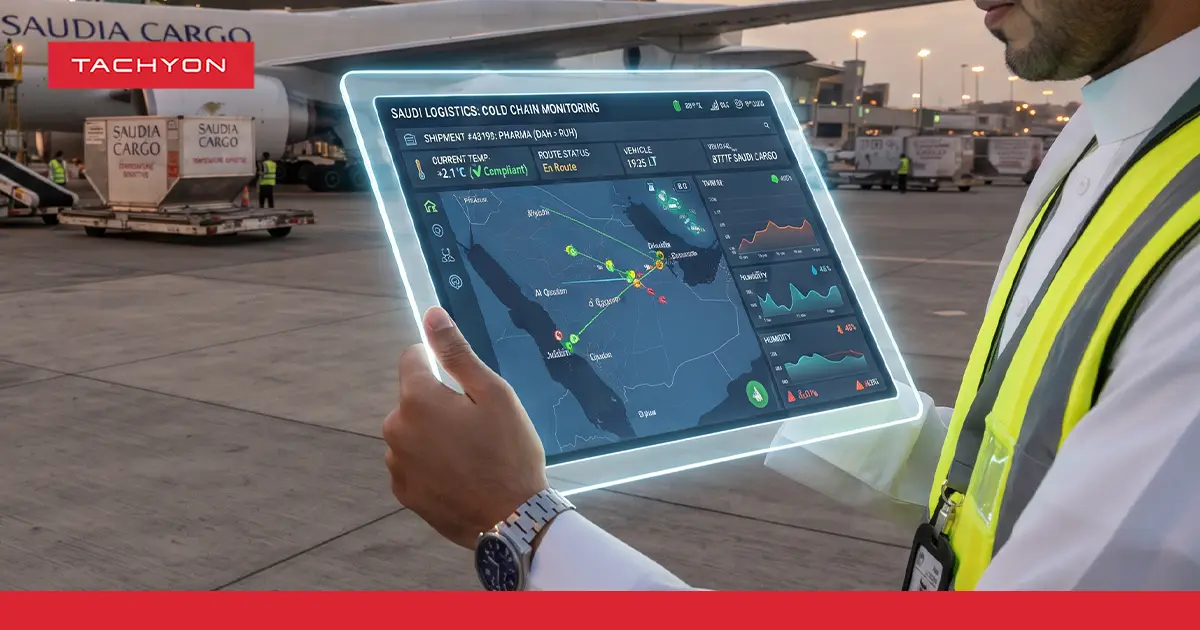
How Does a TMS Support Temperature-Controlled Logistics?
1. Build the Transport Plan Around Shipment Requirements
Temperature controlled logistics requires transportation planning to account for the product, origin, destination, timing, vehicle requirements, and delivery conditions.
2. Associate Shipments With Suitable Transport Resources
The transport process should identify whether a shipment requires refrigerated or otherwise specialized transportation.
3. Keep Shipment Events Connected With Monitoring Data
Departure, delay, arrival, and delivery events provide context when reviewing an environmental excursion.
4. Improve Exception Response
If a temperature alert occurs while a shipment is delayed, transport operations need both condition data and trip information to determine what action is possible.
A connected transport management system can manage shipment planning, trip execution, milestones, and transport visibility around the cold-chain operation.
TachyonTMS provides transport planning, shipment management, live tracking, driver workflows, and integration capabilities; environmental sensor data would need to come from a compatible IoT or monitoring source rather than being assumed to originate from the TMS itself.
How Does Fleet Management Support Reefer Operations?
1. Manage Refrigerated Vehicles as Fleet Assets
Vehicles used for cold-chain transport still require maintenance, documentation, utilization, fuel, driver, and cost management.
2. Coordinate Vehicle Availability
A vehicle that is unavailable for maintenance cannot support a planned temperature-controlled shipment.
3. Connect Vehicle Performance With Delivery Operations
Repeated delays, breakdowns, or vehicle problems can create additional risk for sensitive goods.
4. Centralize Fleet History
Maintenance and operating records help teams understand whether particular assets are associated with repeated reliability problems.
A fleet management system can organize vehicle, driver, maintenance, fuel, tire, and operating-cost information around refrigerated fleet operations. TachyonFMS provides these fleet-management functions, while actual temperature measurement requires appropriate sensing or IoT equipment.
What Does Cold Chain Compliance Look Like in Saudi Arabia?
1. Temperature Monitoring Applies to Relevant Shipments
SFDA states that chilled and frozen food, medical IVD-related products, and shipments requiring specified transport or storage temperatures should use an activated data logger during transportation.
2. Transport Conditions Must Match the Product
SFDA maintains dedicated guidance for transporting and storing chilled and frozen foods, as well as guidance for time- and temperature-sensitive pharmaceutical products.
3. Digital Monitoring Is Part of the Saudi Regulatory Environment
SFDA and the Transport General Authority launched electronic monitoring through Wasl for temperature and humidity in food and pharmaceutical transport vehicles and storage facilities, with integration into transport-sector platforms.
4. Pharmaceutical Transport Requires Specific Attention
SFDA has required refrigerated transportation with temperature indicators for relevant pharmaceutical products and maintains dedicated guidance for time- and temperature-sensitive pharmaceutical storage and transport.
Businesses operating a cold chain Saudi Arabia network should therefore determine the exact SFDA requirements for their product category, transport activity, and storage environment rather than applying one generic temperature policy.
What Is the Difference Between Food and Pharmaceutical Cold Chain Monitoring?
| Area | Food Cold Chain | Pharmaceutical Cold Chain |
|---|---|---|
| Primary Risk | Food safety, spoilage, and quality. | Product quality, stability, safety, and efficacy. |
| Temperature Range | Depends on whether food is chilled, frozen, or otherwise controlled. | Depends on approved product storage conditions. |
| Monitoring | May require transport temperature logging for chilled and frozen products. | Often requires controlled and documented temperature monitoring based on product requirements. |
| Excursion Decision | Evaluated according to food-safety and product requirements. | May require formal quality evaluation before disposition. |
| Documentation | Supports compliance and product-quality verification. | Supports GDP, quality review, release, and investigations. |
| Regulatory Context | SFDA food transport requirements. | SFDA pharmaceutical storage and transport guidance. |
The underlying monitoring technology may be similar, but the decision rules applied to the data can differ substantially.
Which Cold Chain KPIs Should Operations Monitor?
| KPI | What It Helps Measure |
|---|---|
| Temperature Excursion Rate | Frequency of shipments moving outside defined conditions. |
| Excursion Duration | How long shipments remain outside limits. |
| Alerts per Shipment | Frequency of monitoring exceptions. |
| Response Time | How quickly operations react after an alert. |
| Cold Chain Delivery Success | Shipments completed without unacceptable condition events. |
| Reefer Vehicle Downtime | Cold-chain capacity lost because vehicles are unavailable. |
| Warehouse Excursion Rate | Frequency of environmental issues within storage locations. |
| Lane Excursion Frequency | Routes repeatedly associated with temperature problems. |
| Carrier Exception Rate | Temperature or service exceptions associated with transport partners. |
| Product Loss or Rejection Rate | Shipments rejected or lost because required conditions were not maintained. |
These metrics should be interpreted according to product limits and quality procedures rather than compared blindly across different cold-chain products.
How Can Historical Monitoring Data Improve Cold Chain Operations?
1. Identify High-Risk Routes
If excursions repeatedly happen on the same transport lane, teams can investigate route duration, waiting locations, carrier performance, or equipment.
2. Compare Vehicles
Repeated problems associated with a specific refrigerated vehicle may indicate maintenance or operational issues.
3. Find Weak Handoff Points
A pattern of excursions during loading, staging, cross-docking, or receiving can reveal where process controls need improvement.
4. Compare Facilities
Warehouse and transport data can show whether temperature problems originate before dispatch or during the journey.
5. Improve Alert Rules
Historical results help organizations refine thresholds, escalation rules, and operating procedures according to actual risk.
A logistics analytics software layer can help combine cold-chain operational data with transport, warehouse, fleet, and delivery performance information. TachyonInsights currently consolidates information from Tachyon modules into dashboards, KPIs, predictive analytics, and customizable reporting; dedicated temperature sensor data would require the relevant integration or data source.
What Should Companies Check Before Implementing Cold Chain Monitoring?
- Product Requirements: Define the approved or required storage and transport conditions.
- Monitoring Locations: Decide where sensors or data loggers are required across warehouses, vehicles, containers, or shipments.
- Device Accuracy: Confirm that monitoring devices meet the required accuracy and calibration expectations.
- Measurement Frequency: Determine how often environmental readings need to be recorded.
- Communication Frequency: Define how frequently real-time data should be transmitted when connected devices are used.
- Alert Logic: Configure temperature limits, duration rules, and escalation levels according to product requirements.
- Responsible Teams: Identify who receives alerts and who has authority to respond.
- Corrective Actions: Establish clear procedures for excursions and equipment problems.
- System Integration: Determine how monitoring data should connect with TMS, fleet, warehouse, quality, or analytics platforms.
- Data Retention: Establish how long monitoring and corrective-action records need to be retained.
- Saudi Requirements: Verify applicable SFDA and transport requirements for the specific product and operating model.
WHO maintains technical guidance covering monitoring equipment, transport monitoring, fixed storage monitoring, mapping, device accuracy, refrigerated vehicles, and route qualification, making these areas useful components of a structured implementation plan.
How Tachyon Can Support Connected Cold Chain Operations
1. Connect Transportation With Shipment Visibility
TachyonTMS can provide the transportation layer for shipment planning, tracking, driver workflows, milestones, and transport execution around temperature-sensitive shipments.
2. Manage Refrigerated Fleet Resources
TachyonFMS can centralize vehicle, driver, maintenance, fuel, tire, and operating-cost information for fleets that include refrigerated vehicles.
3. Connect Warehouse Operations
TachyonWMS can manage inventory and warehouse workflows around inbound receiving, storage, picking, packing, and outbound activity, helping maintain operational traceability around cold-chain handoffs.
4. Consolidate Operational Intelligence
TachyonInsights brings information from Tachyon’s logistics modules into centralized dashboards and analytics, allowing managers to compare transport, fleet, warehouse, and delivery performance.
5. Integrate External Monitoring Technology
Tachyon states that its platform supports ERP, IoT, GPS, and other system integrations. This creates the technical possibility of bringing data from compatible monitoring systems into a broader logistics environment, subject to the specific integration design and device used.
Cold Chain Monitoring Should Detect Risk Before Product Quality Is Lost
Effective cold chain monitoring is not simply a record of temperatures after a shipment reaches its destination.
A stronger model connects product requirements with monitoring devices, storage conditions, reefer monitoring, transport execution, alerts, corrective actions, and historical analytics.
For temperature controlled logistics in Saudi Arabia, this is particularly important because food and pharmaceutical supply chains operate within product-specific SFDA monitoring and transport requirements.
For food distributors, pharmaceutical companies, healthcare logistics providers, 3PLs, retailers, and businesses operating temperature-sensitive supply chains in Saudi Arabia, contact Tachyon to discuss how transport, fleet, warehouse, IoT, and analytics data can be connected within your logistics operation.
FAQs About Cold Chain Monitoring
What Is Cold Chain Monitoring?
Cold chain monitoring is the measurement and recording of environmental conditions affecting temperature-sensitive products during storage, transportation, and distribution.
What Is Reefer Monitoring?
Reefer monitoring focuses on refrigerated transport equipment and can combine temperature information with vehicle or shipment status, location, and equipment-related data depending on the technology used.
Is GPS Enough for Cold Chain Monitoring?
No. GPS shows location, while cold-chain control requires environmental information such as temperature and, where relevant, humidity or other conditions.
Does Every Cold Chain Shipment Use the Same Temperature Range?
No. Required conditions depend on the product, approved storage instructions, regulatory requirements, and transport profile.
What Is a Temperature Excursion?
A temperature excursion occurs when monitored conditions move outside the predefined acceptable limits for the product or shipment.
Does a Temperature Excursion Mean the Product Must Be Rejected?
Not automatically. The excursion normally requires assessment according to its temperature, duration, product requirements, stability information, and applicable quality procedures.
What Is the Difference Between a Data Logger and Real-Time Monitoring?
A traditional logger records data for later retrieval, while a connected real-time device can transmit current readings and generate alerts while the shipment is still in transit.
Why Is Temperature Mapping Important?
Temperature mapping identifies variations within warehouses, cold rooms, refrigerators, freezers, or other controlled environments so monitoring points can be selected based on actual conditions. WHO identifies mapping and monitoring as integral to appropriate pharmaceutical storage.
What Does SFDA Require for Temperature-Sensitive Shipments?
SFDA states that chilled and frozen foods and shipments requiring specific transport or storage temperatures according to manufacturer instructions should contain an activated data logger during transportation. Additional requirements depend on the product category.
Can Cold Chain Monitoring Connect With a TMS?
Yes. A TMS can provide shipment, route, location, timing, and milestone context around environmental monitoring data when compatible systems are integrated.
Can Cold Chain Monitoring Work Inside Warehouses and Vehicles?
Yes. WHO publishes separate technical guidance for monitoring temperature and humidity in fixed storage areas and transport operations.
Why Is Real-Time Monitoring Useful?
It can make an excursion visible during transportation, giving the operations or quality team an opportunity to investigate and respond before the journey is complete.
