
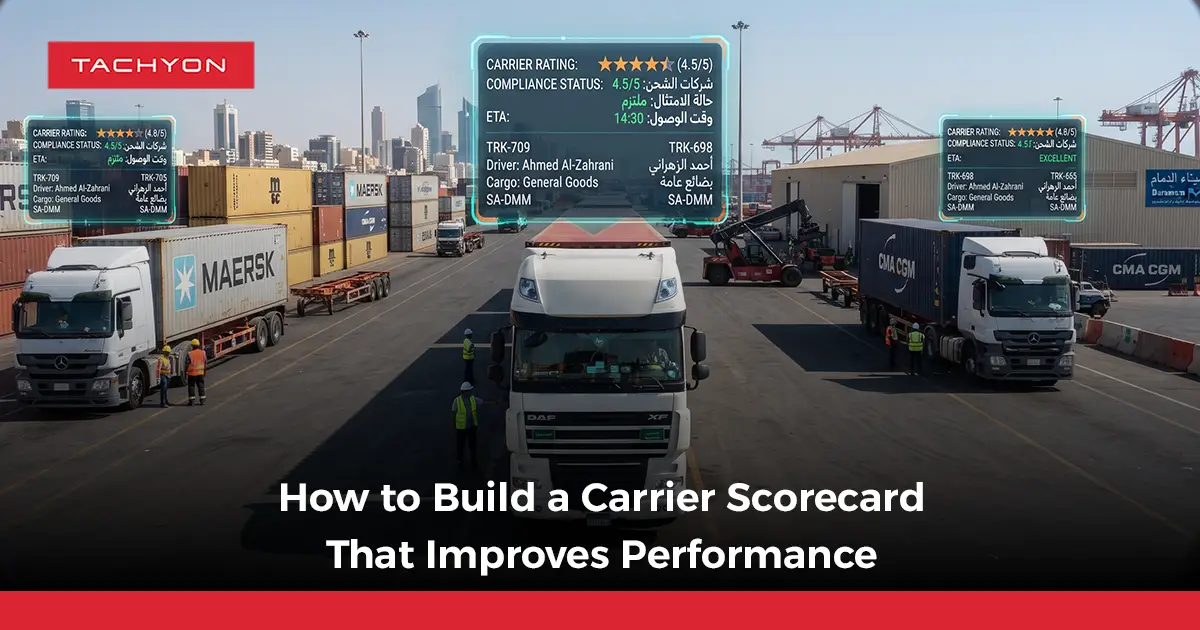
A carrier performance scorecard is a structured method for measuring how reliably each carrier performs against defined operational, service, cost, and compliance criteria.
Instead of selecting carriers based only on price or personal experience, logistics teams can compare actual performance using metrics such as on-time pickup, on-time delivery, tender acceptance, shipment exceptions, claims, documentation quality, and cost performance.
Key Takeaways
- A carrier scorecard converts shipment history into comparable performance data: It should rely on executed transportation activity rather than subjective impressions.
- Price should not be the only carrier-selection criterion: Reliability, capacity, service quality, and compliance also affect total transportation performance.
- Different carrier types may need different scorecards: A refrigerated carrier, parcel carrier, and heavy-haul provider should not automatically be measured against identical criteria.
- Tender acceptance matters: A low-cost carrier provides limited value if it frequently declines assigned shipments.
- Carrier allocation should use performance data: Historical performance can support decisions about how much future volume each carrier receives.
- Onboarding and performance management are different: Onboarding confirms whether a carrier is eligible to work; the scorecard determines how well it performs after operations begin.
- Saudi carrier management must include compliance: Licensing, operating documentation, vehicle suitability, and driver requirements should be treated separately from commercial performance.
What Is a Carrier Performance Scorecard?
A carrier scorecard combines selected KPIs into a repeatable framework for comparing transportation providers.
| Scorecard Area | Main Question |
|---|---|
| Service Reliability | Does the carrier execute shipments when promised? |
| Tender Performance | Does the carrier accept the work allocated to it? |
| Cost Performance | Does actual transportation cost remain within expected levels? |
| Capacity Reliability | Can the carrier provide the capacity it commits to? |
| Shipment Quality | Are goods delivered without avoidable loss or damage? |
| Documentation | Are required documents accurate and submitted on time? |
| Exception Management | How effectively does the carrier handle problems? |
| Communication | Are status updates timely and useful? |
| Compliance | Does the carrier maintain required operational credentials? |
| Improvement | Is performance improving or deteriorating over time? |
A good scorecard does not simply ask whether a carrier is “good” or “bad.” It identifies where the carrier performs well, where it fails, and whether those weaknesses matter for the specific transport operation.
Why Is Carrier Price Alone a Weak Selection Method?
1. A Low Rate Can Be Offset by Poor Reliability
A cheaper carrier that frequently arrives late can create warehouse waiting time, missed delivery appointments, production disruption, and customer-service problems.
2. A Rate Has Little Value Without Capacity
A carrier may offer an attractive contracted rate but repeatedly decline tenders when capacity becomes tight.
Oracle specifically includes Tender Acceptance Percentage in its carrier-performance reporting alongside on-time pickup and delivery.
3. Service Failures Create Additional Costs
Redelivery, detention, damaged goods, customer escalation, emergency replacement transport, and manual intervention can increase the true cost of using a carrier.
4. Different Shipments Have Different Priorities
The lowest-cost carrier may be suitable for routine freight but inappropriate for urgent, high-value, temperature-sensitive, or tightly scheduled shipments.
SAP Transportation Management supports carrier selection using factors including cost, priority, business share, and transportation allocations rather than treating lowest price as the only possible selection rule.
Which KPIs Should Be Included in a Carrier Performance Scorecard?
1. On-Time Pickup Rate
Measures how often a carrier arrives or collects the shipment within the agreed pickup window.
Formula:
`On-Time Pickups ÷ Total Eligible Pickups × 100`
A low result can indicate capacity problems, poor scheduling, driver delays, or unrealistic agreed pickup windows.
2. On-Time Delivery Rate
Measures the percentage of deliveries completed within the agreed delivery requirement.
Formula:
`On-Time Deliveries ÷ Total Eligible Deliveries × 100`
Oracle uses on-time pickup and on-time delivery as core elements of its standard carrier scorecard.
3. Tender Acceptance Rate
Shows how frequently the carrier accepts transportation assignments offered to it.
Formula:
`Accepted Tenders ÷ Total Tenders Offered × 100`
A carrier can perform well after accepting shipments but still create capacity problems if it rejects a large share of assigned work.
4. Cancellation or Tender Rejection Rate
Tracks how often transport work is rejected or cancelled after allocation.
When a carrier declines a tender in Oracle Transportation Management, the shipment can move to another eligible service provider, demonstrating how carrier rejection directly affects subsequent allocation and execution.
5. Damage or Claims Rate
Measures shipments associated with damage, loss, or formal claims.
6. Documentation Accuracy
Tracks whether proof of delivery, transport documents, invoices, and other required records are complete and correct.
7. Cost Variance
Compares expected or contracted transport cost with actual transport cost.
Formula:
`Actual Cost − Expected Cost`
The purpose is not always to reward the cheapest carrier. It is to identify unexpected cost changes and determine why they occurred.
8. Exception Rate
Measures shipments that required manual intervention because of delay, missed pickup, routing problems, documentation issues, or other events.
9. Response Time
Tracks how quickly a carrier responds when operations teams request an update or need an exception resolved.
10. Capacity Fulfillment
Measures whether the carrier actually supplies the number and type of vehicles or transport capacity it committed to provide.
Example Carrier Performance Scorecard
| KPI | Carrier A | Carrier B | Carrier C |
|---|---|---|---|
| On-Time Pickup | 96% | 91% | 98% |
| On-Time Delivery | 94% | 97% | 90% |
| Tender Acceptance | 97% | 84% | 95% |
| Capacity Fulfillment | 95% | 89% | 98% |
| Documentation Accuracy | 99% | 96% | 94% |
| Claims-Free Shipments | 99% | 98% | 96% |
| Cost Performance | 88% | 96% | 91% |
| Exception Response | 95% | 90% | 87% |
The table immediately shows why a carrier should not be judged using one KPI.
Carrier B, for example, may perform strongly on delivery and cost but have weaker tender acceptance. Carrier C provides strong capacity but weaker delivery performance.
The correct decision depends on the shipment and route requirements.
Should All KPIs Have the Same Weight?
No. The weighting should reflect the priorities of the transport operation.
For example:
| KPI | Example Weight |
|---|---|
| On-Time Pickup | 15% |
| On-Time Delivery | 25% |
| Tender Acceptance | 15% |
| Capacity Fulfillment | 15% |
| Cost Performance | 10% |
| Claims / Damage | 10% |
| Documentation | 5% |
| Exception Response | 5% |
| Total | 100% |
These percentages are an example scoring model, not an industry standard.
Oracle’s own standard Carrier Score Card uses a different example: 30% on-time delivery, 30% on-time pickup, and 40% tender acceptance.
This demonstrates an important principle: the scoring formula should reflect the organization’s operational priorities rather than copying another company’s weights.
How Do You Calculate an Overall Carrier Score?
Suppose a carrier achieves:
- On-Time Pickup: 96%
- On-Time Delivery: 94%
- Tender Acceptance: 90%
- Capacity Fulfillment: 95%
If the chosen weights are:
- Pickup: 20%
- Delivery: 30%
- Tender Acceptance: 25%
- Capacity: 25%
The weighted score would be:
`(96 × 0.20) + (94 × 0.30) + (90 × 0.25) + (95 × 0.25)`
The result is:
93.65 points out of 100
The value of the score is not the number alone. Its real value is allowing carriers to be compared consistently across the same agreed criteria.
Why Should Carrier Scores Be Segmented by Route or Operation?
1. Performance Can Vary by Lane
A carrier may perform extremely well between Riyadh and Dammam but have weaker capacity on another lane.
A single network-wide score could hide this difference.
2. Vehicle Requirements Differ
Performance for refrigerated transport should not automatically be combined with flatbed, tanker, dry-van, or specialized transport activity.
3. Customers Have Different Service Requirements
Some customers prioritize cost, while others require strict delivery windows or specialized vehicle types.
4. Distance Affects Operational Performance
Long-haul transportation creates different performance conditions from short urban movements.
5. Shipment Priority Matters
Urgent shipments may require stronger emphasis on acceptance, response, and on-time performance.
SAP carrier-performance reporting can analyze performance using dimensions including carrier, transportation service level, transportation mode, origin, and destination, supporting more detailed analysis than a single global score.
What Is the Difference Between Carrier Onboarding and Carrier Scoring?
| Carrier Onboarding | Carrier Performance Scoring |
|---|---|
| Happens before or at the start of the relationship. | Happens after operational data becomes available. |
| Confirms eligibility. | Measures actual performance. |
| Checks documentation and credentials. | Measures service and operational KPIs. |
| Establishes commercial and operational data. | Compares actual outcomes against expectations. |
| Creates the carrier profile. | Updates the carrier’s performance history. |
| Answers: Can we work with this carrier? | Answers: How well is this carrier performing? |
What Should Carrier Onboarding Include?
1. Company and Contact Information
Record the legal entity, operational contacts, escalation contacts, billing information, and relevant business information.
2. Transport Capabilities
Document:
- Vehicle types.
- Fleet or available capacity.
- Operating regions.
- Transport modes.
- Specialized capabilities.
- Relevant shipment restrictions.
3. Commercial Information
Capture negotiated rates, pricing structures, contract validity, payment terms, and applicable service agreements.
4. Service-Level Expectations
Define expected:
- Pickup performance.
- Delivery performance.
- Tender response.
- Documentation.
- Escalation.
- Shipment visibility.
5. Compliance Verification
Confirm applicable licenses, vehicle operating documents, driver requirements, insurance, and other regulatory requirements.
For heavy-goods transportation in Saudi Arabia, current TGA regulations include requirements around vehicle operating cards, valid registration, insurance, technical inspection, professional driver credentials, and connection with the Authority’s electronic platform.
6. System Access and Integration
Determine how shipments, tenders, tracking updates, documents, invoices, and performance data will be exchanged.
A truck aggregation platform can become particularly useful when businesses need access to multiple prequalified transport providers instead of repeating the sourcing and onboarding process independently for every transportation requirement.
How Does Multi Carrier Management Work?
Multi carrier management means maintaining and coordinating several transportation providers within the same logistics network instead of depending on a single carrier.
The process typically requires:
- Carrier Profiles: Store service areas, vehicle capabilities, rates, and operational information.
- Eligibility Rules: Determine which carriers can handle each type of shipment.
- Capacity Data: Identify whether each carrier can accept additional work.
- Carrier Selection: Determine which provider should receive a shipment.
- Tendering: Offer the transportation assignment to the selected carrier.
- Execution Tracking: Record what happens during the trip.
- Performance Measurement: Update carrier KPIs after execution.
- Future Allocation: Use historical performance to inform later decisions.
SAP Transportation Management can automatically determine eligible carriers, create a ranking, assign the preferred carrier, and trigger tendering when configured to do so.

What Is Carrier Allocation?
Carrier allocation determines how transportation volume is distributed across available carriers.
This may be based on:
- Contracted business share.
- Available capacity.
- Lane coverage.
- Vehicle type.
- Service level.
- Transport cost.
- Customer requirements.
- Carrier score.
- Previous performance.
- Current operational conditions.
Carrier allocation is therefore different from carrier onboarding.
Onboarding creates the eligible carrier pool. Allocation decides who receives each shipment or what percentage of future volume each carrier should receive.
How Can Carrier Scores Improve Allocation Decisions?
1. Reward Consistent Performance
High-performing carriers can receive a greater share of appropriate shipments.
2. Reduce Exposure to Weak Performance
Repeated service failures can reduce allocation while the problem is investigated.
3. Match Carriers to Their Strongest Lanes
A carrier does not have to rank first across the entire network to remain valuable. It may be the strongest carrier on a specific route.
4. Create Backup Capacity
Performance history can help identify second- and third-choice providers before the preferred carrier becomes unavailable.
5. Reduce Subjective Selection
Carrier selection can move from:
“We normally use Carrier A.”
to:
“Carrier A currently provides the strongest combination of capacity, service, and cost for this shipment profile.”
A transport management system provides the operational layer needed to connect carrier profiles, shipment planning, tendering, assignment, tracking, and historical performance.
What Happens When the Preferred Carrier Rejects a Shipment?
1. Record the Rejection
The tender should remain recorded so that acceptance performance is measured accurately.
2. Capture the Reason
Capacity shortage, unsuitable equipment, timing, price, or other operational reasons can provide useful context.
3. Move to the Next Suitable Provider
A transportation system can retender the shipment according to carrier ranking or selection rules.
Oracle Transportation Management, for example, can offer a declined shipment to the next eligible service provider according to the configured process.
4. Update Performance History
Repeated declines should become visible in carrier-performance reporting rather than disappearing after the shipment is successfully reassigned.
How Often Should Carrier Performance Be Reviewed?
Weekly Operational Review
Useful for identifying immediate issues such as:
- Repeated late pickups.
- Tender rejections.
- Capacity shortages.
- Missing tracking updates.
- Documentation delays.
Monthly Scorecard
Suitable for comparing carrier KPIs across a meaningful amount of shipment activity.
Oracle’s Carrier Scorecard dashboard supports carrier-performance analysis by month and period, alongside filters such as carrier and region.
Quarterly Business Review
Useful for discussing:
- SLA performance.
- Cost trends.
- Recurring exceptions.
- Claims.
- Capacity commitments.
- Improvement actions.
- Future allocation.
The correct frequency should reflect shipment volume. A carrier handling hundreds of trips each week generates meaningful performance information more quickly than one used only several times per quarter.
How Do You Avoid an Unfair Carrier Scorecard?
1. Define the Measurement Rules Before Scoring
Both parties should understand what counts as on-time, late, accepted, rejected, damaged, or incomplete.
2. Exclude Events Outside the Carrier’s Control When Appropriate
For example, a vehicle arriving on time should not automatically receive a pickup failure because the shipper had not prepared the goods.
3. Compare Similar Operations
Do not blindly compare an urban parcel carrier with a heavy-haul transporter.
4. Use Enough Shipment Data
A carrier completing two trips should not automatically be ranked above one completing 2,000 trips because both happened to achieve 100% on-time delivery.
5. Preserve the Raw KPI Values
The overall score should not hide the underlying performance.
6. Record Reasons for Exceptions
Context makes it easier to distinguish carrier failures from warehouse, customer, weather, route, or planning problems.
Why Is Data Quality Critical to a Carrier Scorecard?
A carrier scorecard becomes unreliable when:
- Pickup times are entered manually after the trip.
- Planned and actual delivery times are confused.
- Carrier names are recorded differently across systems.
- Rejected tenders are not stored.
- Failed deliveries are removed from the dataset.
- Cost adjustments are not linked to shipments.
- Exceptions do not contain responsibility or reason codes.
The goal is therefore not simply to build a dashboard. It is to create consistent operational events that can be measured automatically.
How Can Logistics Analytics Improve Carrier Performance Management?
1. Compare Carriers Across Multiple KPIs
Managers can identify which carriers deliver the strongest combination of service, cost, acceptance, and capacity.
2. Analyze Trends Over Time
A carrier score of 90 means more when management knows whether it increased from 82 or declined from 97.
3. Analyze Individual Lanes
Performance can be broken down by route, region, customer, vehicle type, or service.
4. Detect Recurring Exceptions
Repeated delays at a location or with a specific carrier can reveal operational patterns.
5. Support Allocation Decisions
Scorecard data can become an input into future carrier selection rather than remaining a report that nobody uses.
A logistics analytics software layer can bring carrier data together with transportation costs, shipment execution, fleet activity, and other logistics KPIs.
Which Carrier Scorecard Metrics Matter Most in Saudi Logistics?
| Metric | Why It Matters |
|---|---|
| On-Time Pickup | Supports reliable origin operations. |
| On-Time Delivery | Measures service reliability. |
| Tender Acceptance | Indicates dependable access to capacity. |
| Capacity Fulfillment | Shows whether promised trucks are actually supplied. |
| Vehicle Suitability | Confirms that the assigned vehicle matches shipment requirements. |
| Driver / Vehicle Compliance | Helps control regulatory exposure. |
| Shipment Documentation | Supports transport traceability and administration. |
| Exception Rate | Identifies shipments needing intervention. |
| Claims / Damage | Measures shipment-quality issues. |
| Cost Performance | Helps control transportation expenditure. |
| Tracking Completeness | Measures visibility across transport execution. |
Current Saudi heavy-goods regulations require service providers to monitor truck and driver performance during transport and record information including speed, driving and rest hours, stops, distance readings, date, time, license number, and operating-card information.
This means carrier management in Saudi Arabia should not be reduced to price and delivery time alone.
How Should Compliance Affect the Carrier Score?
Compliance needs special treatment.
A carrier should not receive a high overall score that hides a critical regulatory failure.
A useful model is therefore to separate:
Eligibility Criteria
Mandatory requirements that determine whether the carrier can be used at all.
Examples include relevant licensing, driver credentials, operating documentation, insurance, and vehicle requirements.
Performance Criteria
KPIs used to compare eligible carriers after they begin operating.
Examples include on-time delivery, tender acceptance, capacity, cost, claims, and communication.
This prevents a weighted average from making serious compliance problems appear acceptable because the carrier has strong commercial performance.
How Does Order Data Connect With Carrier Performance?
Carrier measurement begins before the vehicle moves.
The transport operation needs to know:
- Requested pickup date.
- Requested delivery date.
- Shipment priority.
- Customer requirements.
- Origin and destination.
- Shipment quantity.
- Required transport service.
When an order management system passes consistent order information into transport planning, the operation has a clearer baseline against which actual carrier performance can later be measured.
Without a reliable planned requirement, measuring “on-time” becomes much less meaningful.
How Tachyon Can Support Carrier Performance Management
1. Manage Carriers Within Transportation Operations
TachyonTMS includes transporter and client management, shipment planning, dispatch, tracking, trip milestones, documentation, and performance monitoring within its transportation environment.
2. Access Prequalified Transport Capacity
Tachyon’s Truck Aggregation offering handles carrier prequalification and selection and states that its network includes more than 15,000 trucks across several vehicle types, including flatbeds, refrigerated vehicles, dry vans, low beds, and tankers.
3. Use Operational Data to Evaluate Performance
TachyonInsights consolidates data from Tachyon products into dashboards with KPIs, operational monitoring, reporting, and analytics.
4. Connect Allocation With Actual Transport Execution
Instead of evaluating carriers separately from shipment operations, transportation, transporter management, tracking, and performance data can remain connected within the wider Tachyon logistics environment. Tachyon also identifies carrier management and shipment allocation among its Truck Aggregation capabilities.
Conclusion: A Carrier Scorecard Should Improve the Next Shipment
A carrier performance scorecard should do more than rank transport providers at the end of the month.
Its real value comes from connecting historical carrier behavior with future carrier allocation, tendering, contract reviews, capacity planning, and exception management.
Effective multi carrier management therefore follows a continuous process: qualify suitable carriers, define clear service expectations, collect execution data, measure comparable KPIs, identify problems, and use those results to improve future carrier decisions.
For manufacturers, distributors, retailers, 3PL providers, and logistics businesses in Saudi Arabia managing multiple transport providers, Tachyon can help connect carrier management, transport execution, truck capacity, and logistics analytics within a unified digital environment.
FAQs About Carrier Performance Scorecards
What Is a Carrier Performance Scorecard?
A carrier performance scorecard is a structured set of KPIs used to evaluate transportation providers according to service, capacity, cost, quality, and other relevant performance criteria.
What Are the Most Important Carrier KPIs?
Common metrics include on-time pickup, on-time delivery, tender acceptance, capacity fulfillment, claims, documentation accuracy, exception rate, and cost performance.
What Is Tender Acceptance Rate?
It is the percentage of transport tenders accepted by a carrier compared with the total number offered to that carrier. Oracle includes tender acceptance as one of the measures in its Carrier Scorecard.
Should Carrier Cost Be Included in the Scorecard?
Yes, but cost should normally be evaluated alongside service, capacity, quality, and operational reliability rather than used as the only criterion.
How Do You Calculate a Carrier Score?
Each KPI can be given a defined weight, and the carrier’s performance on each metric can then be multiplied by that weight to create an overall score. The weights should reflect the company’s priorities.
Is There a Standard Carrier Scorecard Formula?
No universal formula applies to every operation. Oracle, for example, uses a standard scorecard combining on-time pickup, on-time delivery, and tender acceptance, but other organizations may need additional dimensions.
What Is Multi Carrier Management?
Multi carrier management is the process of maintaining, comparing, selecting, tendering to, and monitoring multiple transportation providers within the same logistics operation.
What Is Carrier Allocation?
Carrier allocation determines how transportation work or volume is distributed among eligible carriers based on factors such as capacity, rates, service requirements, business share, or performance.
What Is Carrier Onboarding?
Carrier onboarding is the process of collecting and validating the commercial, operational, compliance, and system information required before a carrier begins handling shipments.
Should Compliance Be Part of a Weighted Carrier Score?
Compliance should be monitored, but critical requirements are often better treated as mandatory eligibility criteria rather than allowing strong performance in another KPI to compensate for a serious compliance failure.
How Often Should Carrier Scorecards Be Reviewed?
Operational issues can be reviewed weekly, scorecards monthly, and wider carrier relationships quarterly. The appropriate frequency depends on shipment volume and the importance of the carrier.
Can Carrier Performance Affect Future Shipment Allocation?
Yes. Performance data can be used as one input when ranking carriers and assigning future transport volume alongside capacity, cost, route suitability, and service requirements.
Why Should Performance Be Measured by Lane?
A carrier may perform differently across origins, destinations, distances, and service types. Lane-level analysis can therefore reveal performance differences hidden by an overall carrier score.
Can a TMS Automate Carrier Selection?
Yes. Modern TMS platforms can automate parts of carrier selection and tendering according to configured rules. SAP Transportation Management, for example, can find available carriers, rank them, assign the preferred carrier, and initiate tendering
