
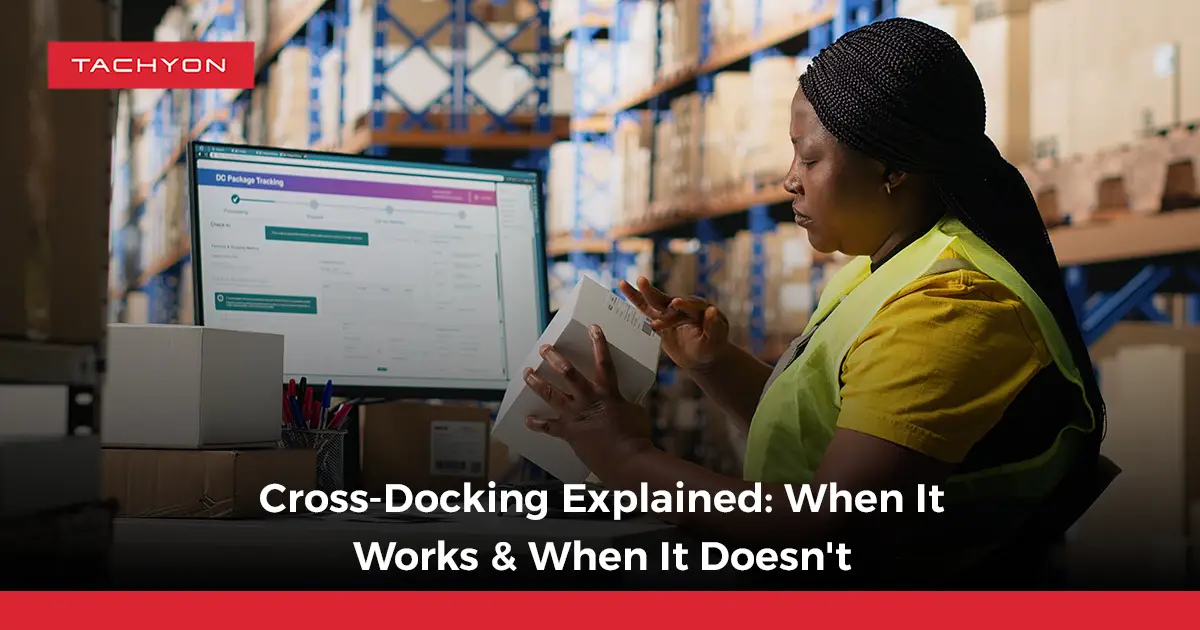
Unlike traditional warehousing, which relies on putting goods away on shelves for days or weeks, cross-docking is built entirely around continuous flow. By moving products straight from the receiving bay to outgoing trucks, companies can bypass the bottlenecks of inventory holding. However, this high-speed model is not a universal fix. Understanding when cross-docking thrives and when it fails is critical for designing a resilient supply chain.
What Is Cross-Docking?
Cross-docking is a logistics practice that unloads materials from an incoming delivery vehicle or manufacturing line and loads them directly into outbound transport vehicles, with minimal or zero intermediate warehousing time in between.
- The Core Mechanism of a Cross Dock:
Rather than staging goods in long-term storage racks, inventory moves through a facility as a continuous transit flow. - The Standard Operational Steps:
- Inbound shipment arrival and unloading.
- Rapid sorting and consolidation of items.
- Direct routing to the outbound shipping dock.
- Immediate loading onto outbound vehicles.
- Final delivery to the destination.
- Storage Duration:
In a true cross-docking operation, goods spend less than 24 hours—and often less than a couple of hours—inside the facility.
How Does Cross-Docking Work?
1. Inbound Shipment Receiving
Suppliers deliver pre-labeled or pre-sorted goods to the facility’s inbound docks, where they are scanned and logged into the system.
2. Sorting and Consolidating Products
Items are quickly broken down, sorted, and matched with matching outbound orders without ever being assigned to a permanent storage slot.
3. Moving Products to the Outbound Dock
Sorted items are consolidated into staging lanes dedicated to specific delivery routes, stores, or end customers.
4. Loading and Shipping
Cargo is rapidly loaded onto outbound trailers or delivery vans to maintain strict departure schedules.
5. Delivery to the Final Destination
The shipment completes its journey swiftly to retail locations or end consumers.
Typical Streamlined Flow:
Supplier → Inbound Dock → Sorting → Outbound Dock → Customer
What Are the Benefits of Cross-Docking?
Implementing a cross-docking model yields profound cross docking benefits when paired with the right operational workflows:
- Reduces Warehousing and Storage Time: Eliminates the need for long-term shelf placement.
- Speeds Up Order Fulfillment: Accelerates the journey from supplier to customer significantly.
- Reduces Inventory Handling: Minimizes human touchpoints and mechanical movement, lowering the risk of damage.
- Can Lower Warehousing Costs: Cuts overhead expenses tied to massive storage footprints.
- Improves Product Flow: Promotes a continuous, uninterrupted movement of goods.
- Supports Faster Delivery: Direct routing meets modern consumer demands for rapid fulfillment.
Cross-Docking vs. Warehousing: What’s the Difference?
To evaluate which operational framework suits your business, it helps to review the structural differences highlighted in a standard cross docking vs warehousing comparison:
| Cross-Docking | Traditional Warehousing |
|---|---|
| Focuses on rapid movement and continuous flow. | Focuses on storage, holding, and asset protection. |
| Minimal or zero intermediate storage space required. | Requires large physical storage facilities and pallet racks. |
| Ideal for predictable, fast-moving goods. | Ideal for safety stock, seasonal items, and long-term holding. |
| Reduces handling and inventory touchpoints. | Involves traditional putaway, picking, and replenishment cycles. |
Is Cross-Docking Better Than Warehousing?
There is no single model that fits every supply chain. The choice depends entirely on product characteristics, demand predictability, supplier reliability, and distribution timelines.
When Does Cross-Docking Work Best?
This is the central question when evaluating the model. Cross-docking succeeds brilliantly under specific operational conditions:
1. When Products Have Predictable Demand
Stable, steady consumption patterns ensure that incoming goods already have guaranteed outbound destinations.
2. When Fast Delivery Is a Priority
When speed to market is paramount (such as with perishable foods or hot-selling retail items), skipping storage is essential.
3. When Inventory Has a Short Shelf Life
Goods that degrade quickly or expire fast cannot afford to sit on warehouse shelves.
4. When Shipments Are Large or Frequent
High-volume flows justify the synchronization required to move goods instantly.
5. When Suppliers and Customers Are Well Coordinated
Tight communication eliminates scheduling mismatches and docking delays.
6. When Products Require Minimal Handling
Items that arrive ready for retail display require zero custom packaging or assembly.
Ideal sectors: Fast-moving consumer goods (FMCG), short-shelf-life groceries, major retail distribution, and pre-allocated shipments.
When Does Cross-Docking Not Work Well?
Knowing the limitations of the model prevents costly supply chain failures:
- When Demand Is Highly Unpredictable: Volatile sales make it impossible to match incoming shipments with immediate outbound needs.
- When Products Need Long-Term Storage: Goods that require holding as safety stock cannot be cross-docked.
- When Inventory Requires Special Handling: Fragile or customized items needing extensive processing do not fit a rapid transfer model.
- When Supplier Shipments Are Inconsistent: Late or erratic supplier deliveries throw off the entire synchronization schedule.
- When Orders Require Extensive Picking: Multi-item orders requiring deep warehouse picking cannot be assembled solely at a dock door.
- When the Supply Chain Lacks Real-Time Visibility: Without robust tracking data, operations grind to a halt.
Types of Cross-Docking
- Continuous Cross-Docking: Incoming items are transferred immediately to outbound trucks without delay as part of an ongoing steady flow.
- Consolidation Cross-Docking: Multiple smaller inbound shipments are combined into a single, unified outbound load destined for a specific customer or store.
- Deconsolidation Cross-Docking: Large bulk shipments arriving from a supplier are broken down into smaller individual packages for localized distribution.
- Pre-Distribution vs. Post-Distribution: Pre-distribution involves goods allocated by the supplier before arrival; post-distribution determines allocation at the cross-dock facility based on real-time data.
What Products Are Suitable for Cross-Docking?
- Stable, high-velocity consumer goods.
- Fresh produce, dairy, and grocery items with tight expiration dates.
- Promotional retail merchandise scheduled for immediate store rollout.
- Pre-allocated customer orders ready for final shipping.
What Products May Require Traditional Warehousing?
- Volatile or unpredictable inventory items.
- Seasonal goods that must be warehoused months in advance.
- Products requiring bundling, kitting, or custom packaging.
- Hazardous or temperature-controlled goods needing specialized storage environments.
- Long-term buffer and safety stock reserves.
Cross-Docking Requirements for Successful Operations
- Accurate Inventory Data: Flawless tracking from suppliers to end destination.
- Strong Supplier Coordination: Strict adherence to delivery schedules and labeling standards.
- Real-Time Shipment Visibility: Complete transparency over truck locations and arrival times.
- Efficient Facility Layout: Specially designed docks with adequate staging lanes to prevent physical gridlock.
- Reliable Transport Scheduling: Flawless synchronization between inbound and outbound carriers.
- Advanced WMS Technology: Software capable of managing rapid dock-door assignments and automated sorting.
- Clear Standard Operating Procedures (SOPs): Disciplined receiving and shipping workflows.
Cross-Docking Challenges and Risks
- Strict Schedule Dependencies: A single delayed inbound truck disrupts the entire outbound dispatch line.
- High Coordination Complexity: Requires absolute harmony between suppliers, carriers, and internal teams.
- Vulnerability to Demand Spikes: Unforeseen order surges can overwhelm dock capacity.
- Zero Room for Error: Mistakes in sorting or labeling result in misdirected shipments.
Cross-Docking vs. Traditional Warehousing: Which Model Fits Your Business?
Choose Cross-Docking When:
- Rapid distribution and short order cycles are top priorities.
- Product demand is steady and easily predictable.
- Inventory velocity is exceptionally high.
- Long-term holding and storage space are unnecessary.
Choose Warehousing When:
- Inventory must be stored safely for extended periods.
- Demand fluctuates unpredictably.
- Safety stock buffers are required to protect against supply disruptions.
- Products require value-added processing or kitting before dispatch.
Consider a Hybrid Model When:
- Your product catalog features a mix of fast-moving staples (ideal for cross-docking) alongside slow-moving or seasonal specialty items (suited for traditional warehousing).
How Technology Supports Cross-Docking
Executing a seamless cross-docking operation requires robust technological infrastructure to coordinate fast-moving freight without the safety net of long-term storage:
- Warehouse Management Systems (WMS): Advanced WMS platforms act as the operational brain, coordinating precise dock-door scheduling, managing inbound/outbound pairing, and directing rapid put-to-store operations.
- Real-Time Shipment Tracking: Integrated tracking tools monitor carrier progress continuously, allowing warehouse supervisors to adjust staging lanes and labor allocations dynamically as trucks approach.
- Barcode and RFID Scanning: High-speed auto-ID technologies eliminate manual data entry errors during frantic sorting windows, ensuring 100% accuracy as items move from bay to bay.
- Automated Routing Engines: Intelligent routing software directs freight instantly from inbound bays to outbound trailers, optimizing travel paths across the dock floor.
How to Decide If Cross-Docking Is Right for Your Supply Chain
Before transitioning your fulfillment model, evaluate your operational readiness against these critical questions:
- ☐ Is customer demand for your products stable and predictable?
- ☐ Are your items high-velocity movers with steady turnover rates?
- ☐ Do you need to eliminate storage overhead and significantly reduce product handling time?
- ☐ Can your suppliers and transport partners commit to strict, unyielding delivery schedules?
- ☐ Do you have real-time visibility systems in place across your network?
- ☐ Do your products bypass the need for customization, kitting, or long-term holding?
- ☐ Is your shipment volume large enough to justify the setup and coordination costs of the transition?
Frequently Asked Questions About Cross-Docking
1. What is cross-docking?
Cross-docking is a logistics practice where incoming goods are transferred directly from receiving docks to outbound transport vehicles with little to no intermediate storage.
2. How does cross-docking work?
It bypasses traditional storage by unloading freight, sorting it rapidly at the dock, and immediately reloading it onto outbound trucks for delivery.
3. What are the benefits of cross-docking?
Key benefits include reduced warehousing time, faster order fulfillment, lower holding costs, and minimized inventory handling.
4. What is the difference between cross-docking and warehousing?
Cross-docking focuses on continuous transit and rapid flow with minimal storage, whereas traditional warehousing centers on long-term inventory holding and management.
5. What products are best suited for cross-docking?
Fast-moving, stable-demand items, perishable groceries, and pre-allocated retail goods.
6. What are the disadvantages of cross-docking?
Risks include tight scheduling dependencies, vulnerability to late deliveries, and high coordination complexity.
7. Is cross-docking cheaper than warehousing?
It often reduces storage overhead, but it requires sophisticated technology, reliable transport, and strict supplier coordination to achieve cost efficiency.
8. When should a business use cross-docking?
When handling predictable, fast-moving inventory that benefits from immediate distribution without the need for long-term storage.
Is Cross-Docking Right for Your Supply Chain?
Evaluating your product flow, storage requirements, and distribution timelines is the first step toward supply chain optimization. Whether your operations thrive best under a pure cross-docking model, traditional warehousing, or a strategic hybrid approach, aligning your logistics strategy with your inventory profile is key to long-term success. Implementing an advanced
supply chain management software
suite ensures that every movement across your docks is fully visible, synchronized, and optimized.
Ready to assess your product flow and choose the ideal fulfillment model?
Contact our logistics experts today to analyze your supply chain and unlock maximum operational efficiency.
