
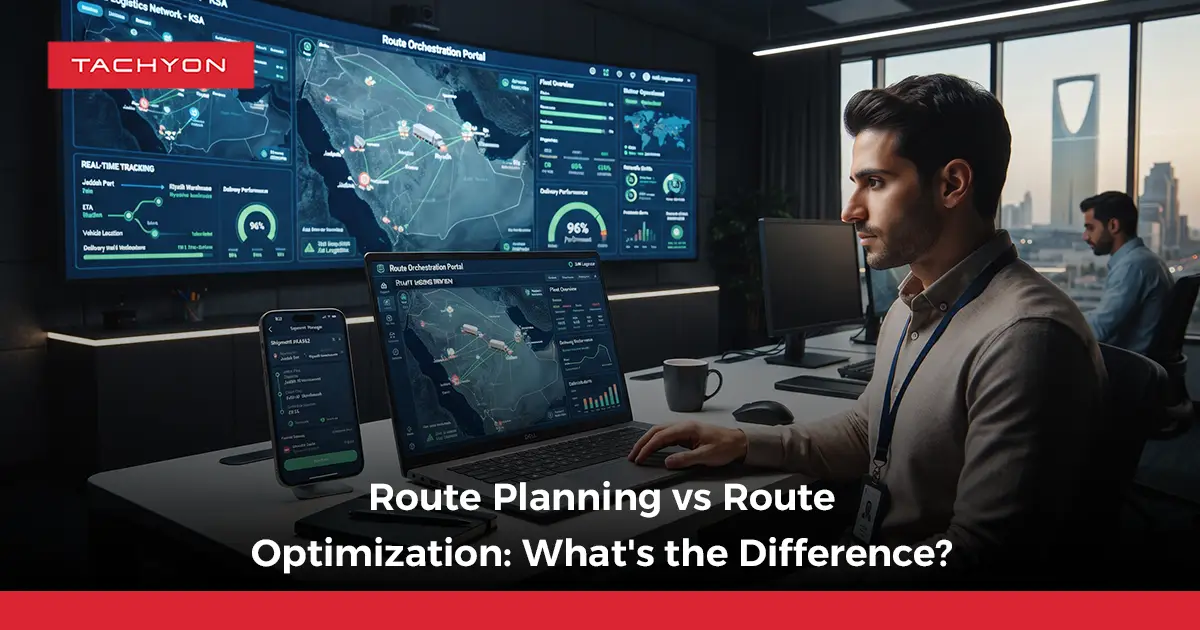
Route planning vs route optimization describes two related but different stages of delivery and transport management. Route planning creates a workable structure for visiting required stops, while route optimization evaluates possible combinations, resources, and constraints to produce a more efficient executable plan.
For logistics teams, the distinction matters because a route can be technically possible without being operationally strong. Modern route optimization software considers time windows, service times, vehicle capacity, driver hours, and multiple vehicles rather than simply finding the shortest distance.
Key Takeaways
- Route planning creates the operational route: It defines how a set of stops can be served.
- Route optimization improves the plan: It evaluates alternatives against business objectives and operational constraints.
- Optimization is not simply finding the shortest road: The shortest route may violate time windows, capacity limits, or driver schedules.
- Planning and optimization can overlap: Some software providers treat route optimization as one stage within the broader planning process.
- Route scheduling adds time and resources: Drivers, vehicles, start times, and expected stop times turn a route into an executable work plan.
- Complexity determines when optimization becomes valuable: Multiple vehicles, many stops, strict SLAs, and capacity rules make manual planning increasingly difficult.
- Dynamic operations require re-optimization: Traffic, new orders, cancellations, delays, and driver problems can make the original route obsolete.
- Results should be measured after execution: Planned distance, actual distance, on-time delivery, overtime, cost, and manual overrides show whether the optimized plan truly performed better.
What Is the Difference Between Route Planning and Route Optimization?
Route planning is the process of creating a workable plan for visiting a set of locations, while route optimization evaluates possible route configurations to identify a more efficient plan while respecting operational constraints.
The terms are sometimes used differently across software vendors. Route optimization is often described as one part of the overall route-planning process.
- Route Planning: Creates a feasible route structure.
- Route Optimization: Searches for a stronger route configuration based on objectives and constraints.
- Route Scheduling: Assigns time, drivers, vehicles, and expected stop timing.
- Dispatch: Sends the approved plan into live operation.
- Navigation: Guides the driver between individual stops.
- Dynamic Re-Optimization: Revises the route after execution begins.
A transport management system becomes useful when route planning needs to remain connected with transport orders, drivers, vehicles, shipment execution, and wider logistics operations.
How Does a Route Move From Orders to an Executable Driver Plan?
1. Collect the Required Stops
The planning process begins with operational demand, including customer orders, delivery stops, pickup points, shipments, service visits, return collections, and transfer jobs.
2. Define the Start and End Locations
Routes may begin or end at a warehouse, distribution center, retail branch, depot, driver home location, or cross-dock.
3. Capture Stop Requirements
Each stop contains specific rules, including delivery windows, service times, priority, handling requirements, and pickup-before-delivery dependencies.
4. Identify Available Drivers & Vehicles
The operation must know which drivers are working, available, qualified, and limited by shift hours. Vehicle constraints include type, capacity, weight limit, volume, and access restrictions.
5. Build a Feasible Initial Route Plan
Route planning organizes the work into a structure that can realistically be executed, ensuring all required stops can be served within the operating day.
6. Define the Optimization Objective
The business decides the primary goal: reducing total distance, minimizing driving time, lowering the number of vehicles required, improving on-time delivery, balancing workload, or reducing costs.
7. Run Route Optimization
The system evaluates many possible combinations of stop sequences, vehicle assignments, and driver assignments. Route optimization software evaluates a whole fleet simultaneously rather than optimizing one vehicle at a time.
8. Review the Proposed Routes & Add Scheduling
A planner reviews the output for operational sense. A mathematically efficient route can fail if drivers perceive it as impractical or if local knowledge is missing.
The approved route receives a driver, vehicle, start time, planned stop times, and an expected return time.
9. Dispatch, Track, and Adjust
Drivers receive assigned stops, route sequences, and navigation. Planners monitor traffic, delays, completions, and route deviations once execution starts.
Route Planning vs Route Optimization: Side-by-Side Comparison
| Area | Route Planning | Route Optimization |
|---|---|---|
| Primary Question | How can these stops be completed? | What is the best feasible way to complete them? |
| Main Output | Workable route structure | Improved route configuration |
| Stop Sequencing | Manual, experience-based, or rule-based | Algorithmically evaluated |
| Multiple Vehicles | Can be manually allocated | Can be optimized together |
| Time Windows | Considered during planning | Used as constraints during optimization |
| Vehicle Capacity | Must be checked manually or through rules | Can influence allocation automatically |
| Driver Hours | Added to the operational schedule | Can restrict feasible solutions |
| Service Time | Included in the plan | Influences sequencing and feasibility |
| Business Objective | May not be explicit | Usually defined: time, distance, cost, vehicles, service |
| Real-Time Changes | Often require replanning | Dynamic systems can re-optimize |
| Best Fit | Simple or predictable operations | Complex multi-stop, multi-resource operations |
Which Constraints Turn a Simple Route Plan Into an Optimization Problem?
- Multiple Stops & Vehicles: As stop counts grow, manual sequencing and vehicle allocation become impossible.
- Vehicle Capacity: Routes must respect strict limits on weight, volume, pallets, and equipment.
- Delivery Time Windows: A route arriving at 1:00 PM is operationally invalid if the customer only accepts deliveries between 10:00 AM and 12:00 PM.
- Driver Working Hours: Routes must fit shift starts, shift ends, maximum working time, and break requirements.
- Service Time: Ignoring service time (parking, unloading, documentation) is a primary reason plans generate unrealistic ETAs.
- Pickup-Before-Delivery Rules: The optimization engine must maintain specific logical sequences.
- Road and Access Restrictions: Modern enterprise optimization accounts for EV range, charging, site rules, low-emission zones, and city restrictions.
A fleet management system helps provide the driver and vehicle information needed for this planning layer.
What Exactly Does Route Optimization Software Optimize?
Optimization should begin with a clear business objective rather than assuming one mathematical measure defines the best route. Objectives include:
- Reducing total distance and driving time.
- Minimizing the number of vehicles required to complete the workload.
- Reducing empty mileage and unproductive vehicle movement.
- Balancing driver workload to prevent burnout and overtime.
- Improving on-time delivery and protecting customer time windows.
- Increasing stop density to boost capacity without adding fleet resources.
- Improving fleet-wide performance rather than optimizing one trip independently.
How Is Route Scheduling Different From Route Planning and Optimization?
- Route Planning: Answers what route structure can serve the required work by organizing stops and resources.
- Route Optimization: Answers which feasible configuration performs best by evaluating alternatives based on distance, time, and cost.
- Route Scheduling: Answers when and with which resources the route will be executed. It connects optimized geography with actual working time and service commitments.

Static Planning vs Dynamic Route Optimization
- Static Route Planning: Works well for recurring distribution runs, regular replenishment, and fixed service territories where volumes are predictable.
- Dynamic Route Optimization: Recalculates feasibility and re-sequences stops when new orders, cancellations, traffic congestion, or driver absences occur..
A (last mile delivery software) layer becomes particularly useful after dispatch, when route decisions need to remain connected with driver assignments, tracking, live delivery status, and changing field conditions.
When Is Basic Route Planning Enough—and When Is Optimization Necessary?
- Basic Route Planning Is Enough When: One driver completes the route, there are few stops, delivery windows are wide, and routes repeat regularly.
- Route Optimization Is Necessary When: Multiple drivers operate simultaneously, delivery windows are strict, vehicles have varying capacities, service times vary, and same-day demand frequently alters routes.
Where Do Route Planning and Optimization Fail in Real Operations?
Optimization cannot repair unreliable operational data. Route-optimization quality depends heavily on accurate map data, geocoding, traffic, and operational inputs. Common failures include:
- Incorrect addresses and poor geocoding.
- Missing service times and ignored loading times.
- Wrong vehicle capacity assignments.
- Outdated driver schedules and missing break times.
- Unrealistic delivery windows.
- Using distance as the sole objective at the expense of service performance.
- Disconnected order data.
Which KPIs Show Whether Route Optimization Actually Improved the Plan?
- Planned vs. Actual Distance & Drive Time: Reveals whether travel-time assumptions were realistic.
- Stops per Route & Stops per Driver Hour: Measures route and labor productivity.
- On-Time Delivery Rate & Delivery Window Compliance: Shows whether optimization supports service performance.
- Vehicle & Capacity Utilization: Measures how effectively fleet resources are being used.
- Driver Overtime: Reveals whether efficient-looking routes depend on excessive working time.
- Cost per Delivery: Connects routing decisions with economics.
- ETA Accuracy: Measures how closely the planned arrival matches reality.
A logistics analytics software layer can connect planned routes with actual distance, time, fleet utilization, delivery outcomes, costs, and operational exceptions.
How Tachyon Connects Route Planning With Route Optimization
- Build Routes From Real Transport Requirements: TachyonTMS supports transportation workflows, scheduling, vehicle coordination, and tracking to ensure routes originate from actual logistics requirements.
- Keep Driver and Vehicle Constraints Connected: Tachyon’s fleet capabilities provide a centralized environment for managing vehicles and drivers.
- Move From Planning Into Live Last-Mile Execution: TachyonBullet links the optimized route to the driver performing the work via real-time dispatch, tracking, and route guidance.
- Adjust Routes When Conditions Change: Tachyon adjusts routes based on real-time operating conditions and continuously analyzes data to improve performance.
- Keep Planning and Last-Mile Connected: Transport orders, driver assignment, route optimization, tracking, and delivery completion operate in a single, connected ecosystem.
Move From Workable Routes to Better Routes With Tachyon
Route planning creates a feasible structure for completing required stops, while optimization evaluates alternatives and constraints to identify a stronger operational configuration.
For transport providers, distributors, retailers, e-commerce companies, 3PLs, and fleet operators in Saudi Arabia, the strongest results appear when planning, optimization, scheduling, dispatch, fleet data, and actual performance remain connected.
Use Tachyon to connect transport planning, fleet resources, smart route optimization, and live execution instead of managing routing as a separate operational task.
Request a Tachyon demo to explore how connected route planning and optimization can improve transport efficiency, visibility, and delivery performance.
Frequently Asked Questions About Route Planning vs Route Optimization
What Is the Difference Between Route Planning and Route Optimization?
Route planning creates a workable structure for completing a set of stops. Route optimization evaluates different combinations of stop sequences, vehicles, drivers, and constraints to find a more efficient feasible plan.
Is Route Optimization Part of Route Planning?
It can be. Some software providers treat route planning as the wider process covering data preparation, optimization, manual review, scheduling, dispatch, and driver execution.
What Is Route Optimization Software?
Route optimization software uses algorithms to evaluate route alternatives and assign stops across routes while considering factors such as time windows, service times, vehicle capacities, driver hours, and business objectives.
Is Routing Software the Same as a Route Planner?
Not always. Basic routing software may provide directions or sequence a limited number of stops, while enterprise route optimization can distribute work across multiple vehicles, handle time windows and capacities, balance workloads, and produce dispatch-ready plans.
What Is the Difference Between Route Planning and Route Scheduling?
Route planning determines how the stops can be organized, while route scheduling assigns timing and resources to the route, including driver, vehicle, route start, stop times, service duration, and expected completion.
Does Route Optimization Always Find the Shortest Route?
No. A useful optimized route may intentionally be longer if that helps satisfy customer windows, vehicle capacity, driver hours, priority deliveries, or another business objective.
What Constraints Does Route Optimization Software Consider?
Common constraints include delivery time windows, vehicle capacity, driver working hours, service time, multiple vehicles, depot locations, vehicle compatibility, customer priorities, road restrictions, and pickup-delivery dependencies.
Can Route Optimization Handle Multiple Vehicles?
Yes. Fleet-level optimization can distribute stops across several vehicles and then optimize each route while respecting vehicle and driver constraints.
What Is Dynamic Route Optimization?
Dynamic optimization recalculates or adjusts routes after execution begins when new information appears, such as new orders, cancellations, traffic, road closures, driver problems, or delivery delays.
When Is Basic Route Planning Enough?
Basic planning is typically enough for operations with a small number of stops, one driver, wide time windows, simple capacity requirements, and predictable routes.
When Should a Business Use Route Optimization Software?
Optimization becomes highly valuable when the operation includes multiple vehicles, many stops, time windows, service-time constraints, strict SLAs, or frequent daily changes.
How Can Businesses Compare Route Planner Software?
A useful route planner comparison evaluates whether each solution supports multi-vehicle routing, time windows, service times, capacity constraints, driver schedules, dynamic changes, dispatch, driver applications, APIs, and planned-vs-actual reporting.
