
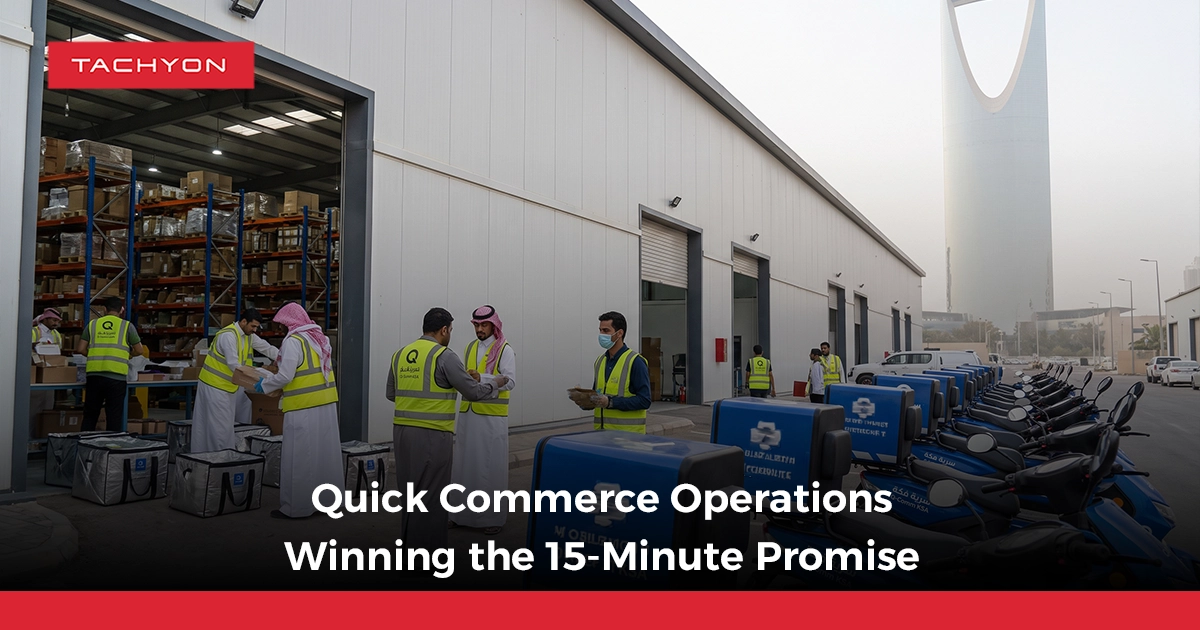
Quick commerce operations do not rely solely on raw delivery speed; rather, they depend on an intricately synchronized operational ecosystem designed to shave seconds off every stage of the fulfillment lifecycle. From the moment an order is placed and inventory is verified to picking, packing, rider assignment, and final drop-off, every micro-step matters.
This is where the core pillars of q-commerce logistics, dark store operations, and micro fulfilment converge to make the 15-minute delivery promise a reality. Businesses operating in this model can also benefit from connected digital logistics solutions that bring order, inventory, fulfillment, and delivery operations together.
What Are Quick Commerce Operations?
Quick commerce operations encompass the hyper-fast, highly localized supply chain and fulfillment framework designed to deliver everyday essentials, groceries, and convenience items to consumers in minutes, typically within 10 to 15 minutes of placing an order.
This operating model is particularly important for grocery and quick commerce logistics, where businesses must coordinate inventory availability, rapid picking, rider assignment, and last-mile delivery within extremely short time windows.
How Do They Differ from Traditional E-commerce Operations?
Unlike traditional e-commerce, which relies on large, centralized warehouses and multi-day shipping windows, quick commerce is built on extreme proximity, hyper-lean inventories, and rapid, localized dispatch.
- Speed of Delivery: Minutes instead of days.
- Inventory Location: Hyper-local dark stores embedded directly inside urban neighborhoods instead of remote fulfillment hubs.
- Order Size: Smaller, frequent baskets consisting of immediate-need SKUs.
- Inventory Management: Real-time stock visibility with rapid turnover.
- Picking and Packing: Executed in minutes within compressed footprints.
- Distribution Model: Direct-to-consumer via dedicated fleets of micro-vehicles such as bikes, e-bikes, and scooters.
For a broader view of how fulfillment, inventory, transportation, and delivery work together in online retail, explore e-commerce and retail logistics.
Why Is 15-Minute Delivery So Difficult?
Achieving a 15-minute delivery window requires absolute operational precision because time is compressed across every single link of the chain:
- Order Placement & Processing: Seconds 0–60
- Inventory Verification: Instantaneous
- Item Picking: Seconds 60–180
- Order Packing: Seconds 180–240
- Handover to Rider: Seconds 240–300
- Dispatch & Route Execution: Seconds 300–600
- Last-Mile Drop-off: Seconds 600–900
The bottleneck is rarely just how fast a delivery rider can drive; it is the flawless synchronization of the entire process behind the scenes.
How Does Quick Commerce Logistics Work?
The end-to-end q-commerce logistics cycle operates as a continuous, tightly integrated automated loop that connects digital demand with physical fulfillment. Once a customer places an order, the system instantly triggers an inventory check, routes the items through rapid picking and packing stations, dispatches the package, and initiates last-mile delivery.
The underlying workflow shares many principles with broader e-commerce logistics operations, but compresses fulfillment and transportation activities into a much shorter operational window.
Real-Time Order Processing
Orders flow directly and instantaneously from the customer-facing mobile application interface to the nearest available fulfillment node, bypassing traditional batching queues to begin processing right away.
Fast Picking and Packing
Equipped with optimized spatial layouts, dedicated pickers gather the requested items rapidly and place them into designated packaging bins to maintain high velocity across the warehouse floor.
Rider Assignment
Advanced algorithms automatically evaluate real-time data to match incoming orders with the closest available delivery rider currently stationed at or immediately adjacent to the facility.
Last-Mile Delivery
Riders navigate dynamically optimized urban routes to bypass congestion and reach the customer’s doorstep within the tight delivery timeframe.
What Are Dark Store Operations?
A dark store is a micro-distribution center optimized exclusively for online order fulfillment rather than walk-in retail shopping.
Unlike traditional retail stores with wide aisles and display counters, dark stores are arranged primarily for maximum picking velocity. Their hyper-local positioning within dense urban areas ensures that inventory sits only minutes away from the target customer base, drastically shortening travel distance.
Dark Store Layout for Faster Fulfillment
- Velocity-Based Slotting: Arranging products according to how frequently they are ordered.
- Minimal Transit Paths: Straight, uncluttered aisles that allow pickers to move fluidly.
- High-Demand Proximity: Placing top-selling items near the packing station to minimize walking time.
- Dedicated Zones: Clearly marked zones for incoming stock, active picking, and final dispatch staging.
Micro Fulfilment and Its Role in Quick Commerce
Micro fulfilment refers to the deployment of small-scale, highly automated storage and staging units positioned in high-density urban areas.
While a dark store operates primarily as a standalone mini-warehouse optimized for human or semi-automated picking, a micro fulfilment center (MFC) often integrates advanced automation, such as vertical carousel modules or automated goods-to-person systems, to push fulfillment speeds even higher.
Micro Fulfilment vs. Dark Store
| Feature | Dark Store | Micro Fulfilment Center (MFC) |
|---|---|---|
| Primary Function | Urban storage and manual/semi-automated picking | Highly automated, compact order staging and sorting |
| Location | Dense residential or commercial urban districts | Ultra-dense city centers or micro-hubs |
| Automation Level | Low to moderate, with manual picking supported by WMS | High, using automated storage, conveyors, or robotics |
| Operations Scale | Medium-sized footprint handling hundreds of daily orders | Highly compact footprint maximizing vertical density |
| Target Orders | Groceries, fresh goods, and daily essentials | High-velocity SKU consolidation and rapid sorting |
How to Design a Quick Commerce Fulfilment Network?
Building a resilient network requires data-backed structural planning:
- Mapping out high-density consumer demand clusters.
- Selecting strategic locations for nodes based on traffic flow and accessibility.
- Defining strict radial service boundaries around each facility.
- Decentralizing inventory across multiple nodes rather than relying on a single mega-warehouse.
- Balancing facility capacity against predicted peak-hour surges.
How Close Should Inventory Be to Customers?
To successfully meet the 15-minute delivery threshold, inventory must generally reside within a short radius of the customer base, helping keep transit times under control even during moderate urban traffic.
How Does Inventory Management Support 15-Minute Delivery?
Precision inventory control serves as the backbone of ultra-fast retail, helping ensure that digital records and physical shelves remain aligned. Without robust stock management, the entire speed framework can quickly break down.
Effective inventory strategies support the 15-minute promise through several key mechanisms:
- Maintaining live, real-time stock counts across every node: Every transaction immediately updates inventory visibility across dark stores, helping prevent the sale of unavailable items.
- Utilizing predictive demand forecasting: Analyzing historical trends, weather patterns, days of the week, and local events allows operators to pre-position high-demand items ahead of peak shopping windows.
- Identifying fast-moving anchor SKUs: Spotting high-velocity products helps prevent sudden stockouts of essential daily goods.
- Automating replenishment triggers: Smart threshold alerts can initiate replenishment before inventory falls to critical levels.
Why Inventory Accuracy Matters in Quick Commerce
In traditional retail, a minor inventory discrepancy might only cause a slight delay or a backorder notification. In quick commerce, however, the margin for error is much smaller.
If a digital system shows an item in stock when it is physically missing from the shelf, the picker wastes valuable time searching for it. This can lead to substitutions, order cancellation, customer dissatisfaction, and missed delivery targets.
How to Optimize Picking and Packing for Quick Commerce?
Every second saved inside the fulfillment facility helps protect the delivery window, making both speed and accuracy critical on the dark store floor.
- Optimize Product Slotting: Group high-affinity items together based on purchasing patterns.
- Batch and Zone Picking: Allow pickers to collect items for multiple orders across assigned store zones.
- Reduce Picker Travel Time: Design logical floor paths that reduce backtracking and congestion.
- Standardize Packing: Use pre-sized packaging and pre-positioned sealing materials.
- Prepare Orders for Fast Dispatch: Stage packed orders directly near the facility exit or rider handover point.
How Does Technology Enable Quick Commerce Operations?
Modern dark store operations are heavily software-driven:
- Order Management System (OMS): Orchestrates orders from checkout to dispatch.
- Warehouse Management System (WMS): Tracks bin locations and directs picking workflows.
- Real-Time Inventory: Helps prevent overselling through continuous synchronization.
- Route Optimization: Computes efficient delivery paths for riders.
- Demand Forecasting: Helps anticipate demand spikes before they occur.
At the center of this process, an Order Management System helps coordinate incoming orders, inventory availability, fulfillment status, and dispatch across multiple operational touchpoints.
Real-Time Visibility Across Quick Commerce Operations
Dashboards provide operators with live visibility into picking bottlenecks, rider queues, stock anomalies, and delivery delays, allowing for faster operational intervention.
How to Optimize Last-Mile Delivery?
- Intelligently match orders to the most suitable nearby rider.
- Use dynamic routing software to respond to congestion.
- Batch adjacent orders for single-rider dispatch when operationally appropriate.
- Reduce dwell time at the dispatch counter through effective staging.
- Manage exception workflows when customers are unavailable or unresponsive.
What Are the Biggest Quick Commerce Operational Challenges?
- Extreme demand spikes during evening hours or weekends.
- Unexpected stockouts disrupting automated workflows.
- High operational and last-mile delivery costs.
- Maintaining strict delivery targets under adverse weather or traffic conditions.
- Managing large, highly dynamic fleets of riders.
How Can Quick Commerce Businesses Handle Demand Spikes?
Businesses can use flexible shift scheduling, dynamic worker pools, pre-kitted high-demand bundles, and predictive stock staging ahead of peak hours.
What KPIs Should Quick Commerce Operations Track?
| KPI | What It Measures |
|---|---|
| Order Cycle Time | Total elapsed time from checkout to doorstep delivery |
| Picking Time | Duration required to gather all items for an order |
| Packing Time | Duration required to box or seal the order |
| Dispatch Time | Time taken to hand the packed order to the rider |
| On-Time Delivery Rate | Percentage of orders delivered within the target window |
| Average Delivery Time | Mean transit time across completed orders |
| Order Accuracy | Percentage of orders fulfilled without missing or incorrect items |
| Inventory Accuracy | Variance between system stock records and physical counts |
| Stockout Rate | Frequency of unavailable items during customer checkout |
| Cost per Order | Total operational and delivery expenditure per completed transaction |
How to Scale Quick Commerce Without Losing Speed?
- Open new dark stores incrementally as order density increases.
- Expand geographically based on verified demand clusters.
- Integrate micro fulfilment hardware where space is constrained.
- Automate repetitive backend workflows.
- Standardize operating procedures across all fulfillment nodes.
Is the 15-Minute Delivery Model Sustainable?
The economics of quick commerce depend on maintaining a careful balance between the cost of speed, basket size, order density, and fulfillment efficiency.
To remain profitable, businesses need to improve dark store utilization, maintain sufficient daily order volumes per node, control last-mile costs, and optimize product assortments and inventory turnover.
How to Build a Winning Quick Commerce Operations Strategy?
- Analyze Demand Density: Map high-potential urban target zones.
- Select Dark Store Locations: Identify accessible urban spaces close to customer demand.
- Design the Fulfillment Network: Balance human workflows with targeted automation.
- Optimize Inventory Planning: Maintain stock accuracy and predictive replenishment.
- Streamline Picking and Packing: Reduce movement and handling times inside the facility.
- Enhance Last-Mile Execution: Deploy smart routing and efficient rider dispatch.
- Monitor KPIs Continuously: Track operational data to support ongoing improvement.
Winning the 15-Minute Promise
Mastering quick commerce operations requires alignment across the entire operational chain. Success is not achieved through fast riders alone, but through the integration of dark store operations, micro fulfilment, accurate inventory management, rapid picking, optimized last-mile execution, and reliable technology.
Only when each stage is engineered for speed and accuracy can a business consistently deliver against aggressive quick commerce targets.
Ready to Elevate Your Quick Commerce Strategy?
Whether you are designing your first urban dark store or scaling a micro-fulfillment network across multiple regions, optimizing every step from inventory to doorstep is essential to building a sustainable operation.
Businesses can use Tachyon’s logistics platform to connect transportation, fulfillment, visibility, and delivery processes within a more integrated digital environment.
Frequently Asked Questions About Quick Commerce Operations
What are Quick Commerce Operations?
They are specialized fulfillment and supply chain processes designed to prepare and deliver goods to consumers within minutes of placing an order.
What is q-commerce logistics?
It is the localized logistics framework governing inventory storage, rapid picking, order preparation, dispatch, and short-radius last-mile delivery.
How does a 15-minute delivery work?
It relies on hyper-local inventory placement, optimized picking workflows, rapid order processing, and automated rider dispatch.
What is a Dark Store?
A dark store is a small-format distribution center optimized exclusively for online order fulfillment rather than in-store retail shopping.
What is Micro Fulfilment?
Micro fulfilment uses compact, technology-driven spaces configured to accelerate order processing and inventory staging in dense urban areas.
What is the difference between a Dark Store and a Micro Fulfilment Center?
A dark store functions primarily as a mini-warehouse for rapid manual or semi-automated picking, whereas a micro fulfilment center generally emphasizes higher levels of compact automation and robotics.
How can businesses reduce Quick Commerce delivery times?
By improving inventory accuracy, streamlining dark store layouts, implementing zone picking, using effective order management, and optimizing rider dispatch and delivery routes.
