
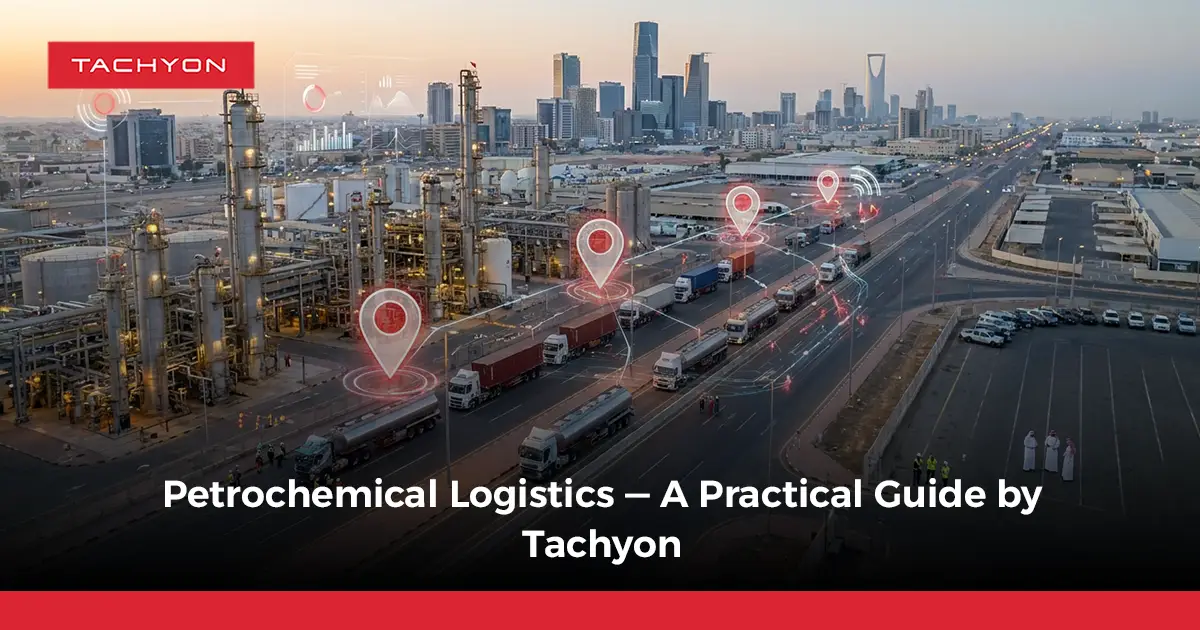
Petrochemical logistics in Saudi Arabia plays a critical role in connecting chemical production facilities, industrial storage terminals, manufacturing customers, and export ports. It involves the specialized transportation and handling of chemical feedstocks, polymers, industrial gases, and liquid bulk commodities.
Unlike general commercial freight, petrochemical transportation requires careful coordination of cargo characteristics, vehicle suitability, driver qualifications, handling procedures, and delivery documentation.
For hazardous products, transportation planning must also consider applicable dangerous goods requirements and the safety procedures established by the shipper, carrier, and receiving facility.
As Saudi Arabia continues to develop its industrial and export infrastructure, petrochemical producers and specialized carriers need reliable logistics processes that support plant-to-port transportation, tanker fleet operations, delivery visibility, and contract-based freight management.
This guide explores the characteristics of petrochemical logistics, its importance in the Saudi market, common operational challenges, and how digital logistics solutions can support safer, more efficient transportation coordination.
What Is Petrochemical Logistics?
Petrochemical logistics refers to the planning, execution, monitoring, and documentation of material movements between refineries, petrochemical production facilities, storage terminals, industrial customers, distribution centers, and export ports.
These operations may involve hazardous and non-hazardous chemical products transported in road tankers, ISO tank containers, dry bulk vehicles, or packaged freight units.
The appropriate transportation method depends on the product’s physical properties, regulatory classification, quantity, packaging, and handling requirements.
1. Specialized Chemical and Hazardous Materials Transport
Some petrochemical products are classified as dangerous goods because of characteristics such as flammability, toxicity, corrosivity, or other hazards.
These materials require transportation equipment, documentation, personnel training, and operating procedures appropriate to their classification and the jurisdictions involved.
Road tankers and ISO tank containers must be suitable for the specific cargo. Depending on the substance and applicable requirements, additional controls may apply to pressure, temperature, compatibility, loading, unloading, and emergency response.
International frameworks such as ADR may be relevant to certain cross-border movements or adopted technical practices, but ADR should not be presented as a universal legal requirement for every domestic petrochemical shipment in Saudi Arabia.
2. Dry Bulk Polymer and Resin Handling
Saudi petrochemical supply chains also transport large quantities of polyethylene, polypropylene, industrial resins, and other polymer products.
These products may move through sealed containers, bulk trailers, pneumatic tankers, or suitable packaged freight arrangements.
Transport operators must consider contamination prevention, packaging integrity, vehicle cleanliness, and the unloading procedures specified for each material.
Consistent handling helps preserve product quality and reduce the risk of rejected deliveries or processing disruptions.
3. Health, Safety, and Environment (HSE) Requirements
Health, Safety, and Environment procedures form an essential part of petrochemical transportation.
Typical controls include vehicle inspections, cargo identification, load compatibility checks, driver training, approved transportation routes where required, and documented emergency procedures.
Some shipments may also require monitoring of operating conditions using suitable instrumentation.
Digital tracking can improve operational awareness and documentation, but it does not replace physical inspections, certified equipment, safe handling practices, or emergency preparedness.
4. Plant-to-Port Export Coordination
Petrochemical exporters must coordinate production schedules, storage availability, tanker dispatches, terminal operations, and vessel-related deadlines.
Delays at loading facilities or receiving terminals may increase transportation costs and cause missed delivery or export windows.
Coordinated scheduling and clear shipment status information can help reduce avoidable waiting and improve communication between the parties responsible for each movement.
Why Petrochemical Logistics Matters in Saudi Arabia
Saudi Arabia is a major global producer and exporter of petrochemical products, making specialized transportation and supply chain coordination important to industrial operations.
Petrochemical logistics supports domestic manufacturing, industrial supply networks, and international export flows.
1. Supporting Major Petrochemical Industrial Hubs
Industrial cities such as Jubail and Yanbu are important centers for chemical production and related industrial activity.
Large-scale facilities require reliable inbound and outbound transportation for raw materials, intermediate products, finished chemicals, and polymer shipments.
High shipment volumes also create complex requirements for assigning appropriate vehicles, coordinating carriers, and keeping accurate delivery records.
2. Improving Industrial Port Connectivity
Petrochemical transportation links production sites and storage facilities with domestic customers and maritime export gateways.
Industrial ports serving Jubail and Yanbu are important to the movement of bulk and packaged industrial products.
Transport teams must coordinate collection and delivery schedules with terminal operating conditions, receiving capacity, and relevant export requirements.
Digital shipment visibility can support this coordination by helping teams identify delays and communicate updated arrival information.
3. Reducing Tanker Waiting and Dwell Time
Tankers may experience extended waiting periods at plant gates, loading racks, weighbridges, and receiving terminals.
These delays can reduce fleet productivity and create additional operating expenses.
Coordinating vehicle arrivals with loading capacity, documentation readiness, and site access procedures can help reduce unnecessary waiting.
However, no scheduling system can guarantee the elimination of congestion, particularly when delays result from production changes, weather conditions, inspections, or terminal restrictions.
4. Strengthening Transport Safety and Documentation
Petrochemical carriers operate in environments where accurate vehicle, driver, cargo, and delivery records are especially important.
Digital systems can help maintain a traceable history of vehicle assignments, shipment movements, and delivery confirmations.
These records may support internal HSE reviews, incident investigations, and compliance activities, depending on the information captured and applicable regulations.
Saudi transportation operators must separately verify which Transport General Authority requirements, industrial security rules, and electronic integrations apply to their specific activities.
5. Improving Fleet Utilization and Cost Visibility
Specialized tankers and bulk transport vehicles can represent a significant operating investment.
Maintenance requirements, fuel costs, vehicle availability, loading schedules, and empty return journeys all influence transportation efficiency.
Better coordination of transport assignments and fleet information can help operators identify underutilized capacity and improve cost analysis.
Common Petrochemical Logistics Challenges and Solutions
| Operational Challenge | Potential Impact | Recommended Approach |
|---|---|---|
| Incorrect vehicle or cargo assignment | Safety risks, shipment rejection, or operational delays. | Verify product requirements, equipment suitability, and driver qualifications before dispatch. |
| Loading rack congestion | Long waiting times and reduced tanker productivity. | Coordinate arrival windows with site capacity and documentation readiness. |
| Limited shipment visibility | Difficulty identifying delays and responding to incidents. | Use suitable vehicle tracking and documented shipment milestones. |
| Inconsistent delivery documentation | Disputes over quantities, delivery times, or freight charges. | Standardize proof of delivery and shipment reference records. |
| Unexpected vehicle breakdowns | Interrupted transportation schedules and higher costs. | Apply preventive maintenance and monitor fleet readiness. |
| Complex contract-based billing | Invoice disputes and time-consuming reconciliation. | Link completed trips to applicable rates, quantities, and contractual terms. |
| Poor export coordination | Missed handover windows and potential terminal or shipping charges. | Align transport plans with confirmed terminal and export requirements. |
How Tachyon Supports Petrochemical Logistics
Petrochemical producers, distributors, and specialized carriers need coordinated transportation planning, accurate trip records, and clear visibility across industrial facilities and delivery destinations.
Tachyon provides digital logistics capabilities for managing high-volume tanker and truck movements, monitoring shipments, documenting deliveries, and supporting contract-based billing.
Businesses can explore petrochemical logistics solutions from Tachyon to understand how the platform supports transport assignments, live tracking, delivery documentation, and operational coordination across plants and terminals.
- Receive shipment requirements and relevant cargo information.
- Verify the required equipment and driver qualifications through approved operating procedures.
- Assign suitable carriers, vehicles, and transportation routes.
- Coordinate collection and receiving schedules with site operators.
- Monitor shipment progress and manage transport exceptions.
- Document delivery completion and reconcile trip information.
- Review fleet performance, transport costs, and service reliability.
1. Enterprise Data Integration
Petrochemical organizations often rely on ERP, plant management, order management, and transportation systems to manage production-related shipments.
Connecting compatible systems can improve the exchange of order references, shipment instructions, contract information, and delivery status records.
Tachyon is designed to integrate with existing ERP and plant systems, supporting more consistent transportation data across operations.
The availability of automatic data synchronization, specific APIs, and plant-specific workflows depends on the integration scope and technical configuration.
2. Controlled Carrier and Vehicle Assignment
Specialized chemical transportation requires careful selection of carriers, drivers, and equipment according to the shipment’s characteristics.
Tachyon supports transport assignment based on operational rules and vehicle availability, while maintaining records of driver and vehicle assignments.
Companies should configure and enforce their own approved qualification, licensing, equipment, and HSE verification procedures.
Digital assignment records can support these controls, but the platform should not be treated as automatically certifying drivers, validating all tanker equipment, or guaranteeing regulatory compliance.
3. Loading Rack and Terminal Coordination
Industrial loading facilities must coordinate incoming trucks with equipment availability, site capacity, and safety procedures.
Structured scheduling information can improve communication between transport planners, carriers, and terminal teams.
Where yard or appointment-management functionality is available and configured, it may support more organized arrival and loading workflows.
Site-specific loading rack automation and terminal integrations should be confirmed during solution planning.
4. Real-Time Tracking and Exception Management
Shipment tracking helps operations teams maintain visibility over tanker and truck movements between plants, terminals, and customers.
Tachyon supports live trip monitoring and helps teams identify transportation delays as they occur.
Where compatible GPS and IoT equipment is integrated, additional vehicle and operational data may be available for monitoring.
Specialized measurements such as cargo temperature, tank pressure, or hazardous substance conditions require suitable certified sensors, available data interfaces, and validated monitoring procedures.
Such telemetry must not be assumed to be included in a standard vehicle tracking installation.
5. Tanker Fleet Management and Maintenance
Heavy transport fleets require careful monitoring of vehicle maintenance schedules, operating expenses, fuel consumption, and availability.
The Tachyon Fleet Management System helps operators manage maintenance activities, fuel usage, tires, vehicle expenses, and driver-related information.
Its GPS and IoT integration capabilities can support additional operational visibility when compatible devices are connected.
These functions can help fleet managers identify upcoming maintenance requirements and plan vehicle availability for scheduled transportation assignments.
They complement, rather than replace, tanker-specific inspections, equipment certification, and cargo-related safety checks.
6. Digital Proof of Delivery and Contract-Based Billing
Accurate delivery records are particularly important in petrochemical logistics because transport contracts may involve volume-based charges, multiple destinations, and specialized handling requirements.
Tachyon supports digital confirmation of completed trips, including time-stamped delivery records and operational histories.
The platform also supports linking completed movements to contractual terms for more consistent transport billing.
Specific documentation, such as digital weighbridge tickets, electronic signatures, or industrial compliance checklists, should be confirmed against available modules and integration requirements.
Key Performance Indicators for Petrochemical Logistics
Petrochemical transportation performance should be monitored through indicators covering service reliability, fleet efficiency, cost control, and operational safety.
- On-Time Delivery (OTD): The percentage of shipments delivered within the agreed delivery window.
- Tanker Turnaround Time: The elapsed time required to complete a defined tanker operating cycle, such as arrival, loading, dispatch, delivery, and return.
- Vehicle Dwell Time: The duration a vehicle spends waiting at a plant, loading rack, weighbridge, or terminal.
- Fleet Availability: The percentage of vehicles available for scheduled assignments.
- Empty Mileage Ratio: The share of vehicle distance traveled without a paying or operationally required cargo load.
- Transport Cost per Tonne: The transportation cost associated with moving a tonne of cargo under a consistently defined calculation.
- First-Time Delivery Completion: The percentage of shipments completed without a failed delivery or rescheduled receiving attempt.
- Billing Accuracy: The proportion of transport invoices that match completed services and applicable contract terms.
- Safety Incident Rate: The frequency of recorded transport-related safety incidents, measured against a suitable operational exposure such as distance or hours worked.
- Preventive Maintenance Compliance: The percentage of scheduled maintenance activities completed within the required period.
Hazardous and non-hazardous chemical movements should be evaluated separately when their safety controls, equipment requirements, or operating conditions differ.
Strategies to Improve Petrochemical Logistics in Saudi Arabia
- Standardize cargo classification: Maintain accurate product information and applicable transportation requirements before selecting vehicles.
- Verify equipment suitability: Ensure tankers, containers, and handling equipment are appropriate for the material being transported.
- Strengthen carrier qualification procedures: Maintain records of approved transport providers, driver training, and equipment inspections.
- Coordinate plant and terminal schedules: Align dispatch plans with loading capacity, delivery appointments, and export deadlines.
- Improve shipment visibility: Use transport status information to identify delays and communicate with relevant operations teams.
- Maintain fleet readiness: Monitor preventive maintenance, fuel usage, and vehicle operating expenses.
- Standardize delivery documentation: Keep reliable references for trips, received quantities, delivery confirmation, and transport exceptions.
- Improve contract billing controls: Reconcile completed transportation activities against agreed rates and service conditions.
- Review transport KPIs: Track delivery reliability, tanker turnaround, dwell time, fleet utilization, and cost trends.
- Maintain independent HSE oversight: Keep safety inspections, incident response procedures, and compliance reviews separate from ordinary logistics performance reporting.
Practical Example: Plant-to-Port Petrochemical Transportation
Illustrative scenario: The example below explains a potential operational workflow. It is not a verified Tachyon customer case study and does not claim measured cost savings or safety improvements.
Operational Challenge
Consider a petrochemical producer that organizes regular shipments between an industrial production facility and an export terminal in Saudi Arabia.
The company works with several specialized carriers and must coordinate loading appointments, equipment availability, driver assignments, and delivery documentation.
Transport information is maintained across separate spreadsheets and communication channels, making it difficult to identify delayed vehicles and reconcile completed trips against freight invoices.
Recommended Digital Workflow
- Record shipment requirements and transport references in a centralized system.
- Check approved carrier and vehicle information through the company’s established procedures.
- Coordinate transport assignments with loading and receiving schedules.
- Monitor trip progress using available tracking integrations.
- Document delivery completion and record relevant exceptions.
- Link completed trips to agreed transportation rates for billing review.
- Evaluate delivery reliability, waiting periods, and fleet availability over time.
How to Measure Results
The operator can compare tanker turnaround times, loading-site waiting periods, on-time deliveries, invoice disputes, and fleet utilization before and after the workflow changes.
Actual savings and performance improvements must be measured from comparable operating periods and validated against changes in shipment volumes, cargo types, and terminal conditions.
The Future of Petrochemical Logistics in Saudi Arabia
The development of petrochemical logistics in Saudi Arabia is closely connected to industrial expansion, modern transportation infrastructure, and the need for reliable export supply chains.
Digital transport management can help organizations coordinate complex carrier networks, improve shipment records, and analyze operational performance across industrial facilities.
Connected tracking and fleet information may also help identify delays, improve maintenance planning, and support more effective utilization of specialized vehicles.
However, technology delivers the strongest results when combined with robust safety procedures, accurate operational data, qualified personnel, and clearly defined responsibilities.
Conclusion
Petrochemical logistics in Saudi Arabia requires a combination of specialized transportation equipment, disciplined operational planning, reliable shipment documentation, and strong safety governance.
Coordinating plant-to-port movements, monitoring tanker fleets, managing delivery records, and maintaining accurate contract billing are important parts of a well-controlled petrochemical supply chain.
Digital logistics platforms can support transportation visibility and operational efficiency, while qualified personnel and established HSE procedures remain responsible for managing cargo-specific risks and regulatory obligations.
Improve Petrochemical Transport Operations With Tachyon
Are tanker scheduling challenges, limited shipment visibility, or complex transport billing affecting your petrochemical operations?
Tachyon helps petrochemical businesses coordinate tanker and truck assignments, monitor active trips, document deliveries, and manage contract-based transportation records.
Explore the platform’s sector-specific capabilities and discuss your operating requirements, integration needs, and transportation workflows with the Tachyon team.
Explore Tachyon’s Petrochemical Logistics Solutions and Request a Demo
Frequently Asked Questions About Petrochemical Logistics
1. What is petrochemical logistics?
Petrochemical logistics involves planning, transporting, handling, storing, and documenting the movement of chemical feedstocks, industrial gases, liquid bulk products, polymers, and other petrochemical materials between production facilities, storage terminals, customers, and export ports.
2. How does petrochemical logistics fit into daily operations?
It coordinates daily transport requests, suitable vehicle and driver assignments, loading schedules, tanker movements, delivery documentation, and carrier billing. The process also relies on appropriate cargo safety and site operating procedures.
3. What are the main petrochemical logistics challenges in Saudi Arabia?
Key challenges include specialized equipment requirements, hazardous cargo procedures, high-volume tanker movements, industrial loading congestion, port scheduling, fleet maintenance, and accurate transport documentation.
4. How can fleet management software support chemical transportation?
Fleet management software helps operators monitor vehicle maintenance, fuel usage, operating expenses, and availability. These functions support transport planning but do not replace cargo-specific inspections or dangerous goods compliance procedures.
5. What is tanker dwell time?
Tanker dwell time is the period a tanker spends waiting or remaining at a facility during a defined operating stage, such as gate processing, loading, or unloading. Monitoring it helps companies identify bottlenecks and evaluate scheduling performance.
6. Does GPS tracking guarantee hazardous materials compliance?
No. GPS tracking supports vehicle visibility and operational records, but compliance also depends on the applicable regulations, cargo classification, equipment suitability, driver qualifications, documentation, and safety procedures.
7. Which KPIs should petrochemical logistics teams monitor?
Important indicators include On-Time Delivery, tanker turnaround time, vehicle dwell time, fleet availability, empty mileage, transport cost per tonne, billing accuracy, maintenance compliance, and safety incident rates.
