
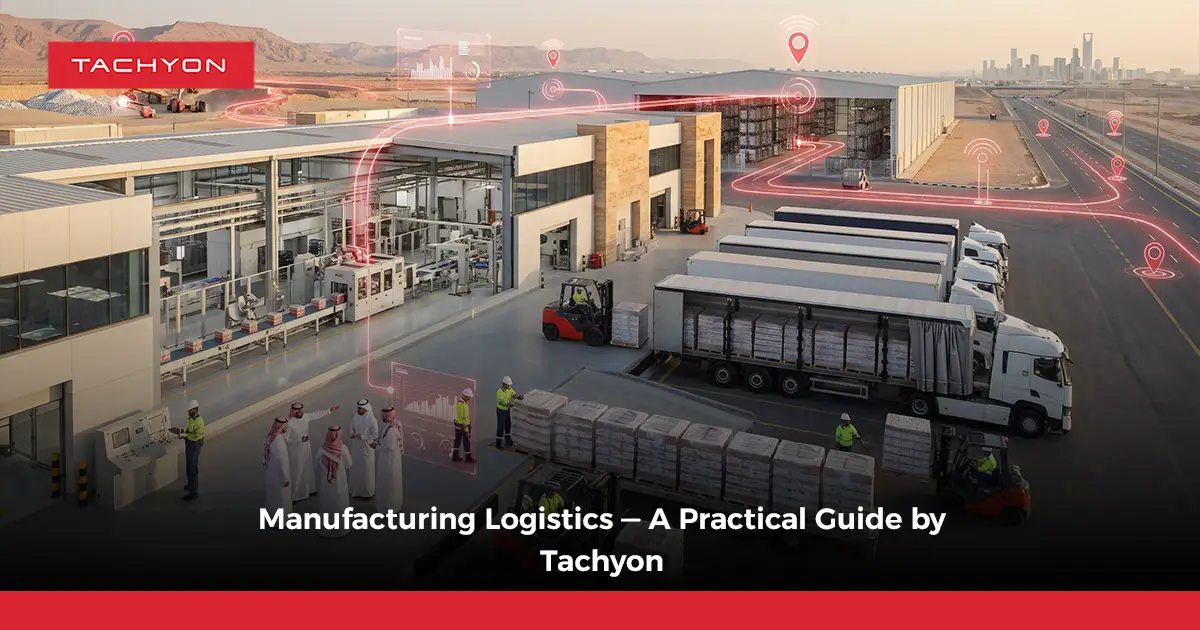
Manufacturing logistics connects raw material suppliers, production facilities, warehouses, carriers, and distribution networks. It ensures that materials reach production lines when needed and that finished goods move efficiently from factories to customers.
In Saudi Arabia, where industrial development and supply chain modernization are strategic priorities, effective manufacturing logistics plays an important role in operational reliability, cost management, and industrial competitiveness.
Without coordinated logistics processes, manufacturing businesses can face raw material shortages, production interruptions, excessive inventory costs, congested loading docks, and delays in outbound transportation.
This guide explains the main stages of manufacturing logistics, their importance in Saudi Arabia, common operational challenges, and how digital logistics solutions support better transport planning, shipment visibility, and fleet management.
What Is Manufacturing Logistics?
Manufacturing logistics refers to the planning, coordination, execution, and monitoring of material flows throughout the manufacturing supply chain.
It includes the movement of raw materials and components into production facilities, the handling of materials within factories, and the storage and distribution of finished products.
Manufacturing logistics generally consists of three interconnected stages.
1. Inbound Logistics
Inbound logistics manages the transportation and receipt of raw materials, parts, and components from suppliers to manufacturing facilities.
Its activities include supplier shipment scheduling, transportation coordination, goods receiving, inventory updates, and delivery planning.
Reliable inbound logistics helps production teams maintain access to required materials while avoiding unnecessary inventory accumulation.
2. In-Plant Logistics
In-plant logistics covers the internal movement, handling, and storage of materials within manufacturing facilities.
It includes warehouse operations, movement of components to assembly lines, production staging, and management of work-in-progress (WIP) inventory.
Manufacturers often apply lean manufacturing principles to reduce unnecessary material movement and ensure that production stations receive the correct components when required.
3. Outbound Logistics
Outbound logistics manages the movement of finished products from production facilities to warehouses, distribution centers, retailers, or business customers.
It includes order preparation, shipment consolidation, vehicle allocation, loading, dispatching, transport tracking, and delivery confirmation.
Efficient outbound logistics helps manufacturers meet customer delivery requirements while managing transportation capacity and distribution costs.
Why Manufacturing Logistics Matters in Saudi Arabia
Saudi Arabia continues to develop its industrial base and logistics infrastructure as part of its broader economic diversification strategy.
Manufacturing enterprises operating across industrial cities and distribution networks require reliable transportation, inventory coordination, and supply chain visibility to support production and delivery requirements.
Supporting Vision 2030 and Industrial Development
Saudi Arabia’s National Industrial Strategy and Vision 2030 emphasize industrial growth, economic diversification, and improved competitiveness.
Industrial locations associated with MODON and the Royal Commission for Jubail and Yanbu illustrate the importance of coordinated logistics across factories, suppliers, warehouses, and transportation providers.
Digital logistics processes can support this environment by improving shipment coordination, operational reporting, and information exchange between supply chain participants.
Improving Manufacturing Export Competitiveness
Transportation and distribution costs influence the total cost of delivering Saudi-manufactured products to domestic and international markets.
Better shipment planning, vehicle utilization, and warehouse coordination can help companies identify avoidable logistics expenses.
These improvements may strengthen manufacturers’ ability to deliver products reliably and compete on service quality and operating costs.
Supporting Just-in-Time Manufacturing
Just-in-Time (JIT) manufacturing aims to align material availability more closely with production requirements, reducing unnecessary inventory and storage costs.
However, JIT operations are particularly sensitive to transportation delays and unreliable supplier deliveries.
For this reason, companies implementing JIT need accurate delivery schedules, dependable suppliers, transport visibility, and contingency arrangements for critical materials.
Digital monitoring can improve coordination, but it cannot eliminate all supply disruptions or guarantee that every delivery will arrive on time.
Connecting Industrial Facilities With Logistics Hubs
Manufacturing supply chains often connect factories with warehouses, logistics centers, dry ports, seaports, and regional distribution networks.
Coordinating these movements helps manufacturers reduce unnecessary waiting and organize deliveries according to production and customer requirements.
Connected logistics information also makes it easier to identify delays across multiple facilities and transport providers.
Improving Transportation Sustainability
Industrial transportation creates fuel consumption and emissions through vehicle movements, idling, and inefficient routing.
Improved trip planning, shipment consolidation, and fewer empty return journeys can reduce avoidable mileage and fuel consumption.
Such changes may contribute to environmental objectives, including those associated with the Saudi Green Initiative, when supported by measurable operational improvements.
Common Manufacturing Logistics Challenges
Manufacturing businesses must coordinate procurement, production, inventory, transportation, and customer deliveries. When these functions operate without consistent information, disruptions in one area can affect the entire supply chain.
| Logistics Challenge | Operational Impact | Recommended Solution |
|---|---|---|
| Delayed inbound materials | Production interruptions and delayed manufacturing schedules. | Improve supplier delivery coordination and shipment tracking. |
| Excess inventory | Higher storage expenses and working capital tied up in stock. | Align inventory planning with production requirements and demand. |
| Loading dock congestion | Vehicle queues, extended waiting times, and delayed dispatches. | Coordinate arrival appointments and loading capacity. |
| Limited transportation visibility | Difficulty detecting shipment delays and informing production teams. | Use suitable transport tracking and shipment status reporting. |
| Unplanned vehicle breakdowns | Disrupted deliveries and increased transport costs. | Monitor vehicle condition and improve maintenance planning. |
| Disconnected systems | Duplicate data entry and inconsistent shipment or inventory records. | Integrate compatible ERP, warehouse, and transport workflows. |
| Inefficient outbound transportation | Low vehicle utilization, unnecessary mileage, and delivery delays. | Improve shipment consolidation, routing, and carrier coordination. |
How Tachyon Supports Manufacturing Logistics
Manufacturers need coordinated information about inbound deliveries, inventory movements, transportation assignments, and outbound shipments.
Tachyon provides digital logistics solutions designed to support transportation planning, warehouse operations, shipment visibility, fleet management, and operational reporting.
Its manufacturing logistics solutions help businesses connect inbound transportation, warehouse activities, and outbound distribution within a more coordinated operational environment.
- Connect relevant order, inventory, and transport information.
- Plan inbound deliveries and outbound transport assignments.
- Coordinate vehicle arrivals, loading, and dispatch activities.
- Track shipment movements and review operational exceptions.
- Record delivery outcomes and analyze performance indicators.
1. Data Integration and Transport Coordination
Manufacturing companies often manage procurement, inventory, production planning, and transportation through different systems.
Enterprise Resource Planning (ERP) software supports business and production processes, while Warehouse Management Systems (WMS) manage warehouse inventory and operations.
Transportation Management Systems (TMS) help organize shipment planning, execution, and monitoring.
Connecting compatible systems can improve information exchange and reduce repetitive manual data entry.
Tachyon is designed to support integrations with ERP and other business systems. The exact integration requirements depend on the software environment, available APIs, and implementation scope.
2. Dock Scheduling and Yard Coordination
Manufacturing facilities can experience congestion when multiple vehicles arrive simultaneously for loading or unloading.
Uncoordinated arrivals may increase driver waiting times, delay goods receiving, and reduce the productive use of loading bays.
Dock scheduling and yard management practices help facilities organize vehicle arrivals, allocate receiving capacity, and maintain clearer information about trailer and truck movements.
Tachyon includes yard management capabilities for coordinating truck and trailer movements. Specific automated dock appointment rules or loading-bay allocation workflows should be confirmed during solution configuration.
3. Real-Time Transportation Visibility
Inbound shipments and outbound deliveries often involve multiple carriers, routes, and delivery locations.
Transport visibility helps manufacturing teams monitor shipment progress, identify potential delays, and communicate relevant information to production or customer service teams.
Tachyon supports shipment tracking and operational reporting, while appropriate GPS and IoT integrations can provide additional vehicle information.
Specialized alerts and monitoring requirements depend on the available tracking data, connected equipment, and configured workflows.
4. Carrier Allocation and Freight Planning
Manufacturers must choose transportation resources according to shipment dimensions, delivery windows, vehicle availability, and operational requirements.
A structured carrier allocation process can improve coordination between internal logistics teams and transport providers.
Digital transportation systems can help centralize shipment requests and assignments while making trip information easier to monitor.
Carrier eligibility, pricing, and specialized transport requirements should still be verified through the organization’s approved procurement and operating procedures.
5. Fleet Management and Operational Performance
Manufacturers operating their own delivery fleets need accurate information about maintenance requirements, fuel consumption, vehicle availability, and operating expenses.
A fleet management system such as Tachyon FMS helps organizations manage vehicle maintenance, fuel usage, expenses, driver-related records, and relevant vehicle operating information.
Its GPS and IoT integration capabilities can also support more consistent monitoring of fleet activity.
With reliable fleet data, manufacturing companies can review vehicle utilization, identify unexpected costs, and improve maintenance planning.
6. Performance Reporting and Analytics
Manufacturing logistics managers need measurable indicators to evaluate transportation reliability and operational efficiency.
Digital reporting provides a structured way to review shipment status, fleet activity, delivery outcomes, and costs.
The most useful performance dashboards are those that reflect actual operating processes and rely on consistently collected data.
Key Manufacturing Logistics KPIs
Manufacturing logistics performance should be evaluated using indicators that connect transportation activities with production reliability and customer service.
- On-Time In-Full (OTIF) Delivery: The percentage of orders delivered within the agreed time window and with the complete required quantity.
- Inbound Delivery Reliability: The percentage of supplier shipments arriving according to the agreed delivery schedule.
- Vehicle Dwell Time: The average waiting and handling time for trucks at factory gates and loading docks.
- Fleet Availability: The proportion of vehicles available for scheduled transportation activities.
- Vehicle Capacity Utilization: The extent to which available vehicle capacity is used for transported cargo.
- Empty Mileage Rate: The proportion of transport distance completed without cargo.
- Transport Cost per Unit: Transportation expenditure divided by the relevant number of units delivered or manufactured, using a consistent calculation method.
- Inventory Accuracy: The degree to which recorded inventory balances match actual stock quantities.
Manufacturers should define the calculation method, reporting frequency, and baseline for each KPI before comparing performance over time.
Practical Strategies for Improving Manufacturing Logistics
Manufacturers can improve logistics performance through a series of operational and technology-focused actions.
- Align transportation with production planning: Coordinate inbound material requirements and outbound delivery schedules with manufacturing activities.
- Improve supplier delivery visibility: Maintain reliable information about shipment status, expected arrival times, and critical material requirements.
- Coordinate factory receiving and loading: Organize truck arrival windows according to available loading docks and warehouse capacity.
- Improve inventory information: Maintain accurate records of raw materials, components, work-in-progress inventory, and finished products.
- Strengthen fleet maintenance: Use service schedules and vehicle operating data to improve transport readiness.
- Review carrier and route performance: Compare delivery reliability, capacity utilization, waiting times, and transport costs.
- Connect relevant business systems: Evaluate integrations between manufacturing, warehouse, procurement, and transportation workflows.
- Measure improvements consistently: Monitor delivery performance, operating costs, and production-related disruptions using defined KPIs.
The Future of Digital Manufacturing Logistics in Saudi Arabia
Digital manufacturing logistics increasingly focuses on connected systems, improved supply chain visibility, more consistent operational information, and better coordination between manufacturing and distribution activities.
As industrial businesses expand, integrating logistics information across suppliers, factories, warehouses, and transportation partners can become increasingly valuable.
Advanced analytics may help identify recurring delays, inefficient vehicle utilization, inventory imbalances, and opportunities for improved planning.
However, successful digital transformation also depends on accurate data, clearly defined workflows, suitable system integrations, and operational readiness.
Technology creates measurable value when it solves specific logistics problems and supports decisions based on reliable performance information.
Frequently Asked Questions About Manufacturing Logistics
1. What is manufacturing logistics?
Manufacturing logistics involves planning, coordinating, and controlling the movement and storage of raw materials, production components, work-in-progress inventory, and finished goods. It covers inbound supplier deliveries, material handling inside factories, and outbound product distribution.
2. How does manufacturing logistics affect daily operations?
Manufacturing logistics influences daily material availability, production schedules, warehouse operations, vehicle allocation, and customer deliveries. Delayed inbound materials can interrupt production, while poor outbound coordination can cause loading dock congestion and missed delivery commitments.
3. What is the difference between inbound and outbound manufacturing logistics?
Inbound logistics manages the receipt and movement of raw materials and components from suppliers to manufacturing facilities. Outbound logistics manages the transportation and distribution of finished goods from factories to customers, warehouses, or distribution centers.
4. How can digital logistics software improve manufacturing operations?
Digital logistics software can help manufacturers organize shipment information, coordinate transportation, monitor delivery progress, manage relevant fleet activities, and analyze operating performance. The benefits depend on integration quality, data reliability, and implementation practices.
5. Which logistics KPIs should manufacturers monitor?
Useful indicators include OTIF delivery, inbound delivery reliability, vehicle dwell time, fleet availability, capacity utilization, empty mileage, transport cost per unit, and inventory accuracy.
Conclusion
Effective manufacturing logistics is essential for industrial companies seeking to maintain reliable production schedules, manage operating costs, and coordinate the movement of materials and finished goods.
In Saudi Arabia, industrial development creates opportunities for manufacturers to improve inbound transportation, warehouse coordination, outbound distribution, and fleet management.
By adopting suitable digital logistics tools, improving data integration, and consistently monitoring operational performance, manufacturers can strengthen supply chain reliability and identify opportunities for greater efficiency.
Optimize Your Manufacturing Logistics With Tachyon
Are delayed raw materials, loading dock congestion, or disconnected transportation processes affecting your manufacturing operations?
Tachyon provides digital logistics solutions that support inbound and outbound transportation, warehouse coordination, shipment tracking, fleet management, and operational visibility.
Discover how these capabilities can support your manufacturing supply chain, and discuss the workflows and integrations relevant to your organization.
Explore Tachyon’s Manufacturing Logistics Solutions and Request a Demo
