
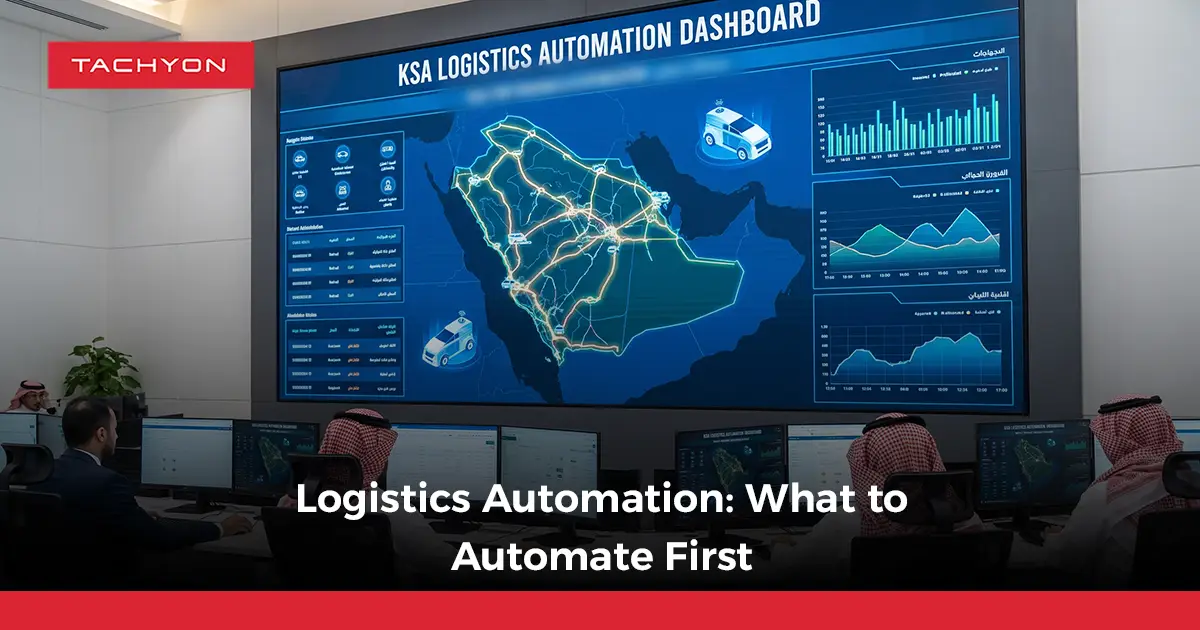
Logistics automation does not mean converting every single supply chain operation into an automated machine overnight. Attempting to automate everything at once usually results in system failures, high capital waste, and operational chaos.
The most effective approach begins by identifying repetitive, data-heavy, and error-prone processes, standardizing them, and then systematically selecting the highest-ROI automation use cases to start with. An integrated digital logistics platform can help businesses connect these workflows across transportation, fleets, warehouses, orders, and delivery operations.
What Is Logistics Automation?
Logistics automation refers to the use of software, robotics, and digital workflows to execute recurring supply chain tasks, manage data movement, and orchestrate physical fulfillment with minimal human intervention.
Automation vs. Digitization: Digitization simply converts analog records into digital formats, such as moving paper shipping logs to a digital spreadsheet, whereas automation takes those digital inputs and executes workflows, calculations, or physical movements automatically based on predefined triggers.
Full vs. Partial Automation: Full automation removes human touchpoints entirely from a designated workflow, such as robotic picking or automated dispatch, while partial automation assists human workers by auto-filling fields, suggesting routes, or flagging anomalies.
Logistics Automation vs. Manual Operations
- Data Entry: Manual typing across systems vs. automated API synchronization.
- Order Processing: Manual batch sorting vs. instantaneous automated validation.
- Shipment Scheduling: Phone calls and spreadsheets vs. automated carrier booking.
- Dispatch: Manual driver assignment vs. algorithmic automated dispatch.
- Reporting: Manual spreadsheet aggregation vs. live analytics dashboards.
Platforms such as logistics analytics software can support this transition by converting operational data into live dashboards and performance insights rather than relying only on manually prepared reports.
What Should You Automate First in Logistics?
When determining where to begin your automation journey, operations managers should evaluate workflows against a strict prioritization framework:
- Highly repetitive, high-frequency tasks.
- High-volume operations choked by manual throughput limits.
- Rule-based processes with clear, predictable logic.
- Operations prone to costly human errors.
- Tasks requiring manual data transfer between multiple siloed systems.
- Workflows that directly impact customer satisfaction or bottom-line costs.
The Top Logistics Processes to Automate First
1. Order and Data Entry
What to automate: Order ingestion, cross-system data validation, and shipping record creation.
Why start here: Order entry is repetitive, rule-based, and highly prone to manual typos. Automating this eliminates upstream bottlenecks that delay downstream fulfillment.
2. Shipment Booking and Scheduling
What to automate: Freight booking, carrier assignment, pickup scheduling, and data transmissions.
Why start here: Replacing manual phone calls and email threads with automated booking speeds up carrier onboarding and minimizes scheduling friction.
3. Automated Dispatch
Automated dispatch uses algorithms to instantly match customer orders with the closest available vehicle or delivery rider, optimizing distribution based on geography, capacity, and time windows.
How Automated Dispatch Improves Delivery Operations
- Reduces administrative assignment time.
- Reduces manual dispatch errors.
- Improves fleet utilization and regional coverage.
- Accelerates the order cycle from checkout to rider departure.
4. Shipment Tracking and Notifications
What to automate: Milestone status updates, customer tracking links, delivery delay flags, and automated proof-of-delivery (PoD) generation.
5. Warehouse Automation
Warehouse automation deploys software and hardware to accelerate internal facility throughput.
- Automated Picking (pick-to-light, voice-picking).
- Automated Sorting and Conveyor Systems.
- Automated Storage and Retrieval Systems (AS/RS).
- Barcode scanning and RFID asset tracking.
When Should You Automate Warehouse Operations?
- Order volumes exceed human picking capacity.
- Picking error rates begin damaging customer retention.
- Labor costs outpace fulfillment revenue.
- Delivery windows demand faster facility turnaround.
6. Inventory Updates and Replenishment
What to automate: Real-time inventory deduction upon order creation, low-stock alerts, and automated purchase reorder triggers.
7. Route Planning and Delivery Optimization
What to automate: Multi-stop route generation, dynamic re-routing, and integration with automated dispatch systems to support last-mile efficiency.
Reducing unnecessary mileage and improving vehicle utilization can also support broader sustainable logistics objectives by helping businesses use transport resources more efficiently.
What Is Process Automation in Logistics?
Process automation in logistics moves beyond isolated task automation to orchestrate complete, multi-step workflows across an organization.
Instead of just automating data entry, process automation manages an end-to-end digital lifecycle:
Order → Validation → Allocation → Dispatch → Delivery → Proof of Delivery
Task Automation vs. End-to-End Process Automation
Task automation focuses on accelerating a single isolated action, such as copying an address into a shipping label, whereas end-to-end process automation stitches multiple connected tasks into a coordinated digital pipeline.
Where Does RPA Fit in Logistics Automation?
RPA logistics (Robotic Process Automation) deploys software “bots” to mimic human interaction with legacy software interfaces.
RPA is ideal for routine, data-dense, rule-based tasks such as:
- Transferring order data between unintegrated ERP and TMS platforms.
- Generating end-of-day operational reports.
- Processing freight invoices and auditing carrier billing discrepancies.
- Updating tracking statuses across multiple vendor portals.
RPA vs. API Integration
API Integration: A direct method for connecting modern software systems and exchanging data in real time.
RPA: A tactical bridge used when legacy software lacks APIs, allowing bots to simulate human clicks and data entry across older interfaces.
For businesses operating multiple logistics systems, reliable logistics system integrations can connect platforms and reduce the manual movement of data between disconnected operational tools.
Warehouse Automation vs. Logistics Process Automation
| Feature | Warehouse Automation | Logistics Process Automation |
|---|---|---|
| Primary Focus | Physical material handling inside the four walls | Digital workflows, data movement, and administrative routing |
| Key Operations | Picking, sorting, conveying, and vertical storage | Order validation, dispatch, billing, and reporting |
| Technology Used | Robotics, conveyors, AGVs, and AS/RS hardware | Software, workflows, RPA, and API integrations |
| Capital Investment | Generally high due to hardware and facility modifications | Generally moderate due to software deployment and configuration |
How to Prioritize Logistics Automation Projects
Determining where to deploy automation first requires a structured evaluation of operational pain points. Operations managers should sequence projects by focusing on specific high-impact criteria.
High-Volume Processes
Focus first on tasks executed hundreds or thousands of times daily. Automating routine, high-frequency actions delivers scalable time savings across the workforce.
Error-Prone Processes
Target workflows where manual data-entry mistakes frequently create financial losses, incorrect shipments, or delayed deliveries.
Time-Critical Processes
Prioritize operations where time directly impacts service-level performance, including driver dispatch, last-minute rerouting, and real-time order validation.
Data-Heavy Processes
Automate tasks that depend on manually moving data across multiple unintegrated systems. Software integrations and automated workflows can remove administrative bottlenecks and accelerate information flow.
Customer-Facing Processes
Tracking engines, automated notification systems, and ETA calculation tools can be important early automation opportunities because they directly affect customer experience.
What Should You Not Automate First?
While automation can improve efficiency, attempting to automate unsuitable workflows can create expensive failures.
Organizations should avoid prioritizing:
- Rare, edge-case operational workflows: Processes that occur infrequently may not justify the engineering or financial investment.
- Unstable, poorly understood processes: Workflows without stable operating procedures may generate exceptions when automated.
- Tasks requiring complex human empathy, negotiation, or nuanced problem-solving: Customer disputes, vendor negotiations, and complex exceptions often require human judgment.
- Badly designed processes: Automating an inefficient workflow can simply reproduce the same inefficiencies faster.
The Golden Rule: Never automate a broken process. Follow the operational sequence:
Standardize → Simplify → Automate → Integrate
How to Build a Logistics Automation Roadmap
Transitioning operations toward greater digital efficiency requires a disciplined, multi-phase execution strategy.
Phase 1 — Identify
Conduct a comprehensive audit of current workflows to map administrative bottlenecks, data silos, and recurring error hotspots across the fulfillment lifecycle.
Phase 2 — Standardize
Establish documented standard operating procedures (SOPs) for every target workflow to ensure operations are stable, repeatable, and ready for digital execution.
Phase 3 — Automate
Select and deploy the appropriate technology stack, such as RPA bots, native WMS workflow rules, or custom scripts, to take over repetitive manual tasks.
Phase 4 — Integrate
Connect newly automated tools to core Transportation Management Systems (TMS), Warehouse Management Systems (WMS), and Enterprise Resource Planning (ERP) software through APIs to support seamless data flow.
Phase 5 — Measure
Continuously track post-implementation performance metrics against established baselines to evaluate efficiency gains, calculate ROI, and refine system parameters over time.
What Technology Enables Logistics Automation?
End-to-end operational automation relies on an integrated technology stack capable of handling physical movement, data orchestration, and automated decision-making.
- Warehouse Management Systems (WMS): Software controlling inventory tracking, bin allocation, and warehouse labor execution.
- Transportation Management Systems (TMS): Platforms supporting carrier selection, freight consolidation, transportation planning, and delivery execution.
- Order Management Systems (OMS): Centralized systems capturing customer orders and coordinating fulfillment workflows.
- Robotic Process Automation (RPA): Software bots that mimic human interaction with legacy interfaces.
- APIs and Middleware Integration: Technology enabling bidirectional communication between different software environments.
- Barcode and RFID Scanners: Tools capturing product identification data for receiving, picking, and packing.
- Internet of Things (IoT) Sensors: Hardware tracking asset location, environmental conditions, and operational status.
- Industrial Robotics: AGVs, AS/RS systems, and sorting conveyors handling physical throughput.
- Artificial Intelligence and Workflow Engines: Technologies supporting forecasting, dynamic routing, anomaly detection, and automated exception handling.
Automation vs. AI in Logistics
Automation executes predefined rules and workflows efficiently, while artificial intelligence introduces machine learning, prediction, and dynamic decision-making capabilities for more variable operating environments.
Businesses evaluating the next stage beyond rule-based automation can explore how AI in logistics is being applied to demand forecasting, route optimization, predictive maintenance, inventory management, and operational decision support.
How to Measure the ROI of Logistics Automation
Organizations should establish measurable KPIs before implementing automation and compare results against the original operational baseline.
- Order Processing Time
- Labor Hours Saved per Shift
- Human Error Rate
- Total Order Cycle Cost per Order
- Picking and Packing Accuracy
- Automated Dispatch Speed
- On-Time Delivery (OTD) Rate
- Vehicle and Fleet Utilization
Centralized logistics analytics and dashboards can make it easier to monitor these KPIs and compare operational performance before and after automation initiatives.
Common Logistics Automation Mistakes
- Automating chaotic or unstandardized processes before cleaning them up.
- Buying automation technology before defining the underlying operational problem.
- Neglecting system integration and creating new data silos.
- Automating low-value tasks while ignoring larger operational bottlenecks.
- Failing to train staff on new automated workflows.
- Launching complex automation projects without establishing clear KPIs.
Automate the Right Process First
Mastering logistics automation is not about deploying every available tool on day one. Sustainable success relies on identifying processes that combine high repetition, large volume, error vulnerability, and direct service impact.
By following the sequence Standardize → Simplify → Automate → Integrate, companies can reduce manual friction, improve operational efficiency, and build more scalable fulfillment processes.
A connected logistics technology platform can support this progression by bringing transportation, fleet, warehouse, order, integration, and analytics workflows into a more unified digital environment.
Frequently Asked Questions About Logistics Automation
What is logistics automation?
Logistics automation is the use of software, robotics, and digital workflows to execute recurring supply chain tasks and physical fulfillment processes with reduced manual intervention.
What should a logistics company automate first?
Companies should generally begin with high-frequency, data-heavy, rule-based administrative tasks such as order entry, data validation, and automated dispatch.
What is warehouse automation?
Warehouse automation is the deployment of physical machinery, software, and robotics such as conveyors, sorters, and automated guided vehicles to improve internal facility throughput.
What is process automation in logistics?
Process automation coordinates end-to-end digital workflows across multiple departments and systems, connecting activities such as order intake, validation, dispatch, delivery, and proof of delivery.
What is automated dispatch?
Automated dispatch uses algorithms and predefined operational data to match customer orders with suitable available vehicles or drivers.
How is RPA used in logistics?
RPA software bots handle repetitive, rule-based administrative tasks across systems, including invoice processing, data entry, reporting, and status updates.
Is logistics automation expensive?
Costs vary significantly depending on the type of automation. Software-based process automation and RPA typically require different levels of investment from physical warehouse robotics and facility automation.
How do you calculate the ROI of logistics automation?
ROI can be evaluated by comparing improvements in labor hours, error rates, processing time, delivery performance, utilization, and operating costs against the total cost of implementation.
