
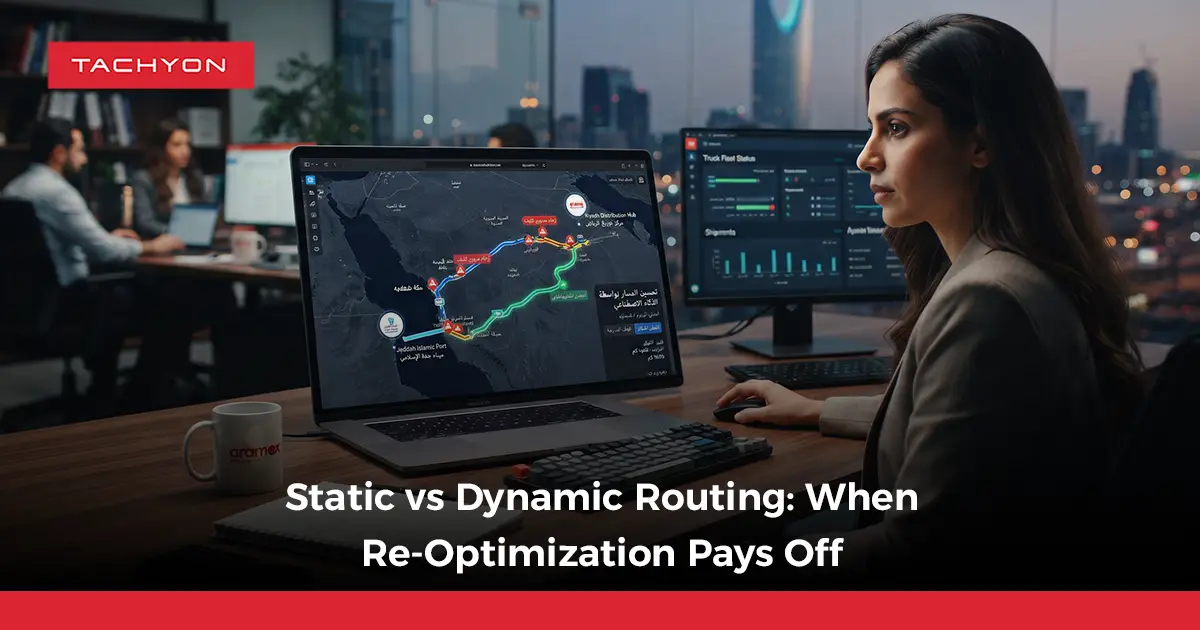
Static vs dynamic routing describes two different ways logistics teams manage delivery routes after planning begins. Static routing relies on routes that remain fixed or largely unchanged, while dynamic routing can adjust the remaining plan as orders, traffic, drivers, vehicles, or customer conditions change.
For delivery and fleet operations, the real difference is not simply fixed versus flexible. It is whether live operational information can trigger real-time route optimization, change assignments, update stop sequences, and protect delivery commitments after dispatch.
Key Takeaways
- Static routing prioritizes predictability: Routes remain fixed or require manual intervention when conditions change.
- Dynamic routing prioritizes adaptability: Live operational information can influence the remaining route after execution begins.
- Not every daily optimized route is truly dynamic: Some platforms call daily re-planning dynamic even when the route becomes fixed after dispatch.
- Real-time re-optimization should use the current state: Completed stops, driver locations, remaining capacity, delays, and delivery windows all matter.
- Not every event should change the route: Excessive re-optimization can create route churn, driver confusion, and unstable customer ETAs.
- Static routing remains valuable: Repetitive distribution, predictable demand, and stable territories may benefit more from consistency.
- Hybrid routing can combine both models: Core stops can remain stable while urgent or variable work is inserted dynamically.
- Live fleet information is essential: Dynamic routing becomes unreliable when driver locations, vehicle status, or capacity data are outdated.
- Performance must be measured after execution: A dynamically adjusted route is only better if it improves actual service, cost, or resource utilization.
What Is the Difference Between Static and Dynamic Routing in Logistics?
Static routing uses a route plan that remains fixed or largely unchanged once it has been created, while dynamic routing allows the remaining route to be recalculated or adjusted when new operational information becomes available before or during execution.
In logistics, the terminology is not completely standardized. Some systems use dynamic routing to describe creating a new optimized route every morning from that day’s orders, contrasting predetermined recurring static routes with dynamically generated daily plans. Other platforms use dynamic routing more specifically for real-time re-optimization after vehicles have already been dispatched.
- Fixed Static Route: A recurring route with a largely fixed sequence of stops.
- Batch-Optimized Route: A new plan can be created before dispatch, but it normally remains unchanged afterward.
- Dynamic Route: The active route can change after execution begins.
- Real-Time Route Optimization: Current operational data is used to evaluate the best remaining plan.
- Live Route Re-Optimization: Remaining stops or assignments are recalculated after a meaningful disruption.
- Adaptive Routing: The routing model changes only as much as operating conditions require.
Dynamic logistics routing should also be distinguished from ordinary GPS navigation. A navigation app may simply find another road between two stops if congestion appears.
Logistics re-optimization can potentially change which stop comes next, which driver serves an order, whether an urgent order is inserted, which vehicle carries remaining work, expected arrival times, and the workload distributed across routes.
The broader planning and execution process can sit inside a transport management system when shipment demand, scheduling, vehicles, drivers, route planning, tracking, and transport execution need to remain connected.
TachyonTMS combines transport-planning and operational-visibility capabilities within the same logistics environment.
Static vs Dynamic Routing: Side-by-Side Comparison
| Area | Static Routing | Dynamic Routing |
|---|---|---|
| Planning Moment | Primarily before dispatch | Before and during execution |
| Route Sequence | Fixed or manually changed | Can be recalculated |
| Primary Data | Known or historical data | Known data plus live operational signals |
| New Orders | Often moved to another cycle | Can potentially be inserted |
| Traffic Changes | Limited impact on route structure | Can influence re-optimization |
| Driver Delay | Dispatcher manually responds | Remaining plan can be recalculated |
| Vehicle Breakdown | Manual recovery | Work may be redistributed |
| Customer Changes | More difficult after dispatch | Can influence remaining assignments |
| ETA Accuracy | Can deteriorate as the day changes | Can be recalculated from current progress |
| Dispatcher Workload | Higher during exceptions | More exception handling can be automated |
| Operational Stability | High | Lower if the system changes routes frequently |
| Best Fit | Predictable, repetitive operations | Variable, time-sensitive operations |
Static routing is not automatically inefficient. A fixed route works extremely well when customers repeat, stops are stable, volumes are predictable, drivers know their territories, time windows are wide, and operational disruptions are uncommon.
The real problem begins when operational variability becomes greater than the static route’s ability to absorb it.
When Is Static Routing Still the Better Operational Choice?
- Stops and Demand Repeat Regularly: When the same customers receive deliveries on set days and volume varies only slightly, frequent route changes create little additional value.
- Customer Relationships Benefit From Driver Consistency: Some B2B operations value familiar drivers, regular arrival patterns, and territory knowledge over absolute geographic optimization.
- Delivery Windows Are Wide: A customer accepting goods anytime during an 8-hour window creates less routing pressure than a customer demanding a strict 30-minute window.
- Real-Time Data Is Weak: Dynamic routing depends on current information. If vehicle locations, order status, or driver availability are unreliable, the algorithm may make poor decisions faster rather than better decisions.
- Operational Stability Outweighs Continuous Optimization: Changing a route has a cost. Drivers need to understand the new plan, trust it, and follow it. Predictable operations can continue to benefit from static routes even when dynamic software is available.
When Does Dynamic Routing Become Necessary?
- Daily Order Mix and Volumes Change Significantly: Different customers and quantities every day reduce the usefulness of recurring routes. When same-day orders arrive continuously after dispatch, a fixed morning plan becomes rapidly disconnected from current work.
- Delivery Windows Are Tight: A minor disruption can create cascading SLA failures, requiring immediate system flexibility to adjust.
- Traffic Conditions Are Highly Variable: Dense urban delivery environments require systems that can adapt to rapid changes in road availability and congestion.
- Driver and Fleet Capacity Fluctuates: Real-world fleet operations experience absences, late starts, and unexpected shift changes. When drivers or vehicles support several routes, dynamic rebalancing becomes highly valuable.
- SLA Failure Is Expensive: If missed delivery windows create penalties, failed deliveries, customer churn, or repeat trips, there is immense value in detecting and recovering risks before failure.
- Dispatchers Spend Too Much Time Manually Rebuilding Routes: High manual adjustment, same-day changes, difficult delivery windows, and large differences between plans and actual execution indicate that an operation needs dynamic routing. A (fleet management system) becomes especially relevant here because adaptive route decisions require accurate driver and vehicle context before redistributing work.
What Is a Hybrid Routing Model and Why Do Fleets Use It?
A hybrid routing model combines predictable fixed routes with selective dynamic adjustments. Fleets can keep recurring customers and stable service territories unchanged while re-optimizing only the parts of the plan affected by urgent orders, delays, cancellations, or capacity changes.
This approach helps operations gain flexibility without constantly changing the entire route plan or creating unnecessary driver disruption.
How Does a Route Move From Pre-Dispatch Planning to Live Execution?
1. Orders Enter the Planning Environment
The routing process begins with work such as customer deliveries, pickups, shipments, returns, transfers, service stops, and urgent orders. Each task must contain reliable operational information.
2. Stops Are Geocoded
Customer addresses are translated into usable geographic coordinates. Poor location data can create problems before route optimization even starts.
3. Operational Constraints Are Loaded
The plan may need to respect delivery windows, vehicle capacity, driver availability, working hours, service time, road restrictions, customer priority, depot rules, and pickup-before-delivery dependencies. Modern route-planning systems treat these conditions as strict route constraints rather than optimizing distance alone.
4. Initial Routes Are Created
Orders are grouped and sequenced into feasible route structures.
5. Drivers and Vehicles Are Assigned
The operation determines which resources should perform the planned work.
6. Routes Are Scheduled
The plan receives a route start time, an assigned driver, an assigned vehicle, planned stop times, estimated completion, and return-to-depot timing where relevant.
7. The Plan Is Dispatched
This is where the difference between static and dynamic models becomes clear. In a static model, dispatch largely freezes the plan. In a dynamic model, the dispatched plan becomes the operational baseline rather than the final answer.
8. Live Execution Begins
Vehicles leave, drivers begin completing tasks, and new operational data becomes available.
9. Live Signals Enter the System
These can include GPS positions, completed stops, delays, traffic, new orders, customer changes, and vehicle incidents.
10. The System Checks Whether the Existing Plan Is Still Feasible
A five-minute delay may require no action, whereas a vehicle breakdown affecting ten time-sensitive stops requires immediate system intervention.
11. Remaining Work May Be Re-Optimized
The route can be dynamically re-sequenced, split, reassigned, extended, or shortened.
12. Drivers and Customers Receive Updated Information
If the active plan materially changes, relevant updates may include a new task sequence, new assignments, revised routes, updated ETAs, and customer notifications.

Which Live Events Should Trigger Route Re-Optimization?
Dynamic routing does not mean changing the route every time a new data point arrives. The operation needs rules defining which events are significant enough to reconsider the active plan.
A New Urgent Order Arrives
A same-day priority order may need to enter an active route. The system should assess which driver can accept it, remaining vehicle capacity, customer windows, and the impact on the existing route.
A Customer Cancels or Reschedules
Removing one stop changes route distance, available capacity, and remaining timings. If a delivery window changes drastically, the original sequence may no longer be efficient.
A Driver Runs Late or Becomes Unavailable
One delay can put several later stops at risk. Dynamic routing evaluates whether to keep the route, change stop order, or move work to another driver. An unexpected absence requires remaining work to be fully redistributed.
A Vehicle Breaks Down
Vehicle failure impacts remaining capacity, route completion, and customer commitments.
Traffic and Road Conditions Change
Congestion, closures, restrictions, or incidents can invalidate part of the plan and make the original sequence less practical.
Warehouse Loading Is Delayed
A perfectly optimized route is useless if the vehicle cannot leave the depot at the assumed time.
Delivery Windows Become At Risk
The strongest trigger may not be the disruption itself but its projected consequence. If the system predicts that a high-priority stop will miss its SLA, re-optimization may be justified before failure actually occurs.
What Does Live Route Re-Optimization Actually Recalculate?
The key concept behind live route re-optimization is recalculating the remaining operation from its current state, not as if the delivery day were starting again from zero.
- Remaining Stops: Completed deliveries are historical facts. A live algorithm focuses strictly on what remains to be done.
- Current Driver Position: The driver is no longer at the depot. Their current location becomes the new planning origin.
- Stop Sequence & Travel Time: The order of remaining deliveries and expected movement between them can change based on current traffic.
- Driver Workload & Remaining Capacity: A route may need to lose or receive tasks based on what has already been delivered or collected.
- Remaining Driver Time: The algorithm factors in shift ends, breaks, maximum route duration, and overtime risks.
- Delivery Windows & Priorities: A new sequence must protect time-sensitive and high-priority stops.
- Service Time: The system includes the expected time spent at each destination.
- Updated ETAs: Every meaningful route change must lead to new, highly accurate arrival estimates.
Where Does Dynamic Routing Fail in Real Operations?
- Incorrect Addresses & Poor Geocoding: The algorithm routes to the wrong geographic location or street entrance.
- Outdated GPS Positions: A driver’s actual location differs from the system’s data.
- Wrong Vehicle Capacity: The route assigns work the vehicle physically cannot carry.
- Missing Service Times: Re-optimization underestimates how long unloading or documentation requires at later stops.
- Delayed Order Cancellations: The route continues carrying work that no longer exists.
- Unrealistic Delivery Windows: No feasible route combination can satisfy all promises simultaneously.
- Slow Data Synchronization: The route is optimized using old operational conditions.
- Constant Route Churn: Stop order changes too often, causing extreme driver confusion.
- Customer ETA Instability: Customers receive several conflicting arrival estimates in a short period.
- Excessive Manual Overrides: Dispatchers repeatedly undo system recommendations due to lack of trust or missing constraints.
- Wrong Optimization Objective: The algorithm prioritizes saving distance while harming SLA performance.
Which KPIs Show Whether Dynamic Routing Actually Improved Execution?
- Planned vs. Actual Distance and Time: Compare what the original route expected with what drivers actually traveled.
- On-Time Delivery Rate & Window Compliance: Measures whether route flexibility successfully protected service performance.
- Stops per Driver Hour & Resource Utilization: Shows route productivity and whether fleet capacity is used effectively.
- Empty Mileage: Ensures rebalancing does not create excessive non-productive movement.
- SLA Recovery Rate: Measures how many stops projected to miss their SLA were brought back into compliance after re-optimization.
- Route Churn: Tracks how much of the route changes after dispatch. High churn with little improvement indicates over-optimization.
- Manual Override Rate: High override rates signal missing constraints, weak data, or a lack of trust in the system.
A logistics analytics software layer can consolidate route, delivery, fleet, cost, and exception information for this planned-versus-actual analysis, bringing information into a unified analytics environment for operational monitoring.
How Tachyon Connects Planning With Live Route Decisions
1. Start With Structured Transport Planning
Dynamic execution still needs a strong initial plan. Tachyon provides a transport-management layer for organizing transport operations, scheduling, tracking, and operational visibility before execution. Build a good baseline plan, then adapt when reality materially changes.
2. Keep Live Conditions Visible
Dynamic routing depends on knowing what is actually happening. Tachyon’s platform emphasizes real-time visibility across transport and logistics operations, using live tracking and driver-app data to reduce operational blind spots.
3. Move Beyond Static Planning When Conditions Change
Tachyon’s adaptive-fleet approach revolves around moving beyond rigid planning and reacting to real operating conditions when disruptions, demand shifts, or route problems appear.
4. Carry Route Decisions Into Last-Mile Execution
A route adjustment creates little value if it never reaches the driver. Real-time dispatching, smart route optimization, and live driver updates bridge this gap. A (last mile delivery software) layer is crucial because dynamic route decisions must move directly from planning into the actual driver workflow.
5. Keep Drivers Connected With the Updated Plan
When a route changes, the driver needs one current operational version on their mobile application. This eliminates reliance on phone calls, text messages, manual spreadsheets, and verbal route changes.
6. Measure What Happened After the Change
Dynamic routing must close the feedback loop. The operating cycle becomes: Plan, Dispatch, Track, Detect, Evaluate, Re-Optimize, Update, Execute, and Measure. This is infinitely stronger than generating a route and simply hoping it still works.
Keep Routes Useful After Dispatch With Tachyon
Static vs dynamic routing is not a choice between outdated and modern logistics. Static routes create predictability where demand is stable, while dynamic routing becomes valuable when the operating environment changes faster than the original route can absorb.
For logistics providers, distributors, e-commerce businesses, 3PLs, and fleet operators, the strongest routing model matches real variability while keeping drivers, vehicles, delivery commitments, and live execution under control.
- Use static routes where consistency creates operational value.
- Build a strong baseline route before dispatch.
- Define exactly which events justify re-optimization.
- Recalculate remaining work rather than restarting the day from zero.
- Protect high-priority stops and delivery windows from excessive route churn.
- Keep drivers instantly synchronized with the latest plan.
- Update customer ETAs only after meaningful route changes.
- Compare planned execution against actual performance.
Use Tachyon to connect transport planning, live fleet visibility, smart route optimization, analytics, and last-mile execution instead of letting routing stop when the vehicle leaves the depot.
Contact Tachyon to request a demo and explore how adaptive routing and live route re-optimization can support more resilient delivery and fleet operations.
Frequently Asked Questions About Static vs Dynamic Routing
What Is the Difference Between Static and Dynamic Routing in Logistics?
Static routing uses routes that remain fixed or largely unchanged after planning, while dynamic routing allows the remaining plan to change when new operational information becomes available.
A static operation usually handles disruptions manually, while a dynamic system uses live information to recalculate route decisions.
Is Static Routing the Same as a Fixed Route?
Often, yes. A fixed route normally follows a predetermined sequence of customers or territories on a recurring schedule.
Static routing may also describe a route that was optimized once before dispatch but is not automatically changed during execution.
Is Daily Route Optimization Considered Dynamic Routing?
It depends on the terminology. Some systems call routes dynamic when they are regenerated each day based on current orders.
However, advanced logistics platforms reserve dynamic routing for routes that continue changing intraday after dispatch.
What Is Real-Time Route Optimization?
Real-time route optimization uses current information such as driver location, traffic, active orders, vehicle capacity, delays, time windows, and completed tasks to determine whether the remaining route should change to improve efficiency or save SLAs.
What Is Live Route Re-Optimization?
Live route re-optimization means recalculating part of an active route after execution has already started. Instead of rebuilding the day from the depot, the system evaluates the current driver position, completed work, remaining stops, new orders, and delivery-window risks.
What Is Adaptive Routing in Logistics?
Adaptive routing describes an approach that changes the active plan only when operating conditions genuinely justify it.
The principle is controlled adaptation: preserve stable parts of the route where possible and change only what is strictly necessary to improve execution.
What Events Can Trigger Dynamic Route Re-Optimization?
Common triggers include new urgent orders, cancellations, customer rescheduling, traffic incidents, driver delays, vehicle breakdowns, failed deliveries, warehouse delays, and high-risk delivery windows.
Does Dynamic Routing Change the Entire Route?
Not necessarily. A well-designed system preserves completed and high-priority work while re-sequencing only the remaining stops affected by the disruption. Unnecessary changes reduce driver trust and make customer ETAs highly unstable.
Can New Orders Be Added to a Route After Dispatch?
Yes, when the routing platform supports dynamic order insertion and the active fleet still has feasible capacity, evaluating driver location, current workload, delivery windows, and travel time before inserting the order.
Is Dynamic Routing Always Better Than Static Routing?
No. Static routes can be highly effective when demand is predictable, customers repeat, delivery windows are wide, and driver familiarity creates value.
Routing strategy should match operating variability rather than automatically choosing the most dynamic model available.
What Is a Hybrid Static-Dynamic Routing Model?
A hybrid model combines stable route elements with dynamic flexibility. Recurring customers stay assigned to fixed territories, while same-day orders are added dynamically, giving dispatchers predictability without forcing the whole operation to remain static.
How Does Driver Tracking Support Dynamic Routing?
Live driver tracking shows where the vehicle actually is rather than where the plan expected it to be.
That accurate location data dramatically improves remaining travel calculations, ETA updates, order reassignment, and re-optimization decisions.
