

An on-demand delivery platform connects incoming orders with fulfillment locations, available drivers, dynamic routes, live tracking, and delivery confirmation in real time. Unlike fixed delivery schedules, on-demand operations must respond continuously as new orders, traffic conditions, inventory availability, and delivery capacity change.
Effective on-demand delivery software depends on more than fast dispatch. It must coordinate fulfillment readiness, driver capacity, routing, customer visibility, and performance data to keep instant delivery reliable as order volume grows.
Key Takeaways
- On-demand delivery begins with the order: Orders must enter a structured workflow before fulfillment or driver assignment starts.
- Fulfillment speed affects delivery speed: An available driver cannot compensate for inventory errors or slow picking.
- Driver assignment requires real operating conditions: Location, workload, capacity, route impact, and delivery windows all matter.
- Routing must remain dynamic: New orders, traffic, delays, cancellations, and capacity changes can make an existing route inefficient instantly.
- Q-commerce requires tighter synchronization: Inventory, picking, dispatch, and delivery need to operate with very short handoff times.
- Real-time visibility should reveal risk: Teams need to see pending orders, available capacity, ETA changes, and SLA risks before deliveries fail.
- Speed must remain economically sustainable: Cost per delivery, driver utilization, and fulfillment productivity matter alongside delivery time.
- Connected systems reduce manual coordination: Order, warehouse, last-mile, and analytics data should support the same operational decisions.
What Is an On-Demand Delivery Platform?
An on-demand delivery platform is software that coordinates customer orders, fulfillment locations, drivers, routes, tracking, and delivery confirmation in real time, allowing businesses to fulfill delivery requests shortly after they are placed.
Several related terms describe different parts of the model:
- On-Demand Delivery Software: Focuses on managing operational execution for immediate or short-window deliveries.
- Instant Delivery Platform: A system designed around very short order-to-door delivery expectations.
- Scheduled Delivery: Orders are known and planned before the delivery window begins.
- Q-Commerce Delivery: Quick-commerce fulfillment that combines nearby inventory, rapid picking, and hyperlocal last-mile execution.
- Hyperlocal Delivery: Deliveries fulfilled from nearby stores, hubs, or micro-fulfillment locations within a limited service area.
A centralized order management system can organize incoming demand and keep each order connected with its customer, service requirement, fulfillment location, and downstream delivery workflow.
What Makes On-Demand Delivery Different From Scheduled Delivery?
The main difference is the amount of time available to make decisions. Scheduled routes can be planned in advance, while on-demand orders must be absorbed into an operation that is already running.
| Operational Area | On-Demand Delivery | Scheduled Delivery |
|---|---|---|
| Order Timing | Orders arrive continuously | Demand is known earlier |
| Planning Model | Dynamic | Pre-planned |
| Driver Assignment | Real-time | Planned in advance |
| Routing | Frequently recalculated | Stable |
| Capacity Requirement | Immediate availability is critical | Capacity can be reserved |
| Delivery Window | Usually short | Wider or predetermined |
| Inventory Requirement | Must be ready quickly | Can often be prepared earlier |
| Exception Impact | Immediate SLA risk | Allows more recovery time |
| Customer Visibility | Strong real-time expectations | Often milestone-based |
| Typical Use Cases | Food, grocery, pharmacy, hyperlocal retail | Planned distribution, B2B, subscriptions |
##
How Does On-Demand Delivery Work From Order to Door?
1. The Customer Places an Order
The workflow begins when an order enters through a website, app, marketplace, or retail system. Essential data includes the Order ID, customer details, delivery address, products, requested speed, and special requirements.
2. The Best Fulfillment Point Is Selected
The order is routed to a warehouse, dark store, retail branch, or micro-fulfillment center. The closest location is not automatically the best; the platform must also consider inventory availability, picking capacity, and delivery coverage.
3. Inventory and Order Readiness Are Confirmed
An instant delivery promise relies on actual product availability. The operation confirms inventory, picking status, packing status, and expected ready time.
4. Delivery Capacity Is Checked
The system evaluates available resources, distinguishing between total registered drivers and those actually available to accept another task.
5. The Order Is Assigned
Driver selection considers proximity, existing workload, active routes, vehicle capacity, delivery windows, and the expected resulting route.
6. The Route Is Calculated
The route dynamically connects the pickup point, existing driver stops, and the new delivery while respecting priority and customer time windows.
7. The Order Is Picked Up
The driver arrives only when the fulfillment operation can hand over the order efficiently. Excessive pickup waiting time reduces available delivery capacity.
8. Delivery Progress Is Tracked & Customers Are Updated
The order moves through statuses (Confirmed, Preparing, Picked Up, Out for Delivery, Delivered) while the customer receives automated updates regarding estimated arrival and driver approach.
9. Delivery Is Confirmed
The operation closes with proof of delivery via signature, photo, OTP, barcode scan, or GPS timestamp.
How Does Q-Commerce Delivery Compress the Order-to-Door Timeline?
- Inventory Is Positioned Close to Demand: Inventory is placed inside dark stores, micro-fulfillment centers, or local hubs to reduce both fulfillment and transportation time.
- Orders Route to the Right Location: Fulfillment decisions combine product availability, geographic location, and operational capacity.
- Picking Begins Quickly: Long warehouse queues directly reduce the time available for delivery. A warehouse management system can support inventory visibility, picking workflows, and stock control so the delivery layer receives orders that are actually ready to move.
- Delivery Capacity Is Evaluated Early: Driver assignment overlaps with packing, evaluating expected readiness and nearby capacity simultaneously.
- Pickup and Driver Arrival Are Synchronized: If a driver arrives too early, capacity is wasted. If they arrive too late, delivery times increase.
- Hyperlocal Routes Remain Short: Smaller delivery zones reduce travel time and empty kilometers.
How Should Orders Be Assigned to Fulfillment Points and Drivers?
- Confirm Inventory Availability: The selected location must have enough stock. Do not route orders based solely on customer distance.
- Check Fulfillment Capacity: A nearby location with 40 pending picks will produce a slower order than a slightly farther location with only 5 pending picks.
- Estimate Order Readiness: The dispatch system must understand exactly when the order will become ready.
- Evaluate Driver Workload: The nearest driver may already have multiple deliveries. Assigning another task may cascade delays across the whole route.
- Match the Vehicle to the Order: Consider order size, temperature requirements, delivery distance, and product sensitivity.
- Reassign When Conditions Change: Allow reassignment if a driver becomes unavailable, fulfillment is delayed, traffic spikes, or higher-priority orders arrive.
How Do Dynamic Dispatch and Route Optimization Keep Instant Delivery on Time?
- Dispatch Demand as It Arrives: On-demand delivery absorbs new tasks instantly rather than waiting for a complete batch of orders to plan.
- Use Real Driver Availability: The system must know if a driver is available, assigned, picking up, delivering, or off shift.
- Evaluate the Resulting Route: The closest driver is not always the fastest driver once existing stops are considered. Advanced routing inserts new orders into active routes seamlessly.
- Respect Active Deliveries: Adding a new order should not unnecessarily delay customers already on the driver’s route.
- React to Traffic and Delays: A route that was efficient 20 minutes ago recalculates dynamically.
- Balance Workloads & Reduce Empty Movement: Prevent driver overload and minimize unproductive movement to reduce delivery costs and SLA risks.
A last mile delivery software environment can support real-time dispatch, driver assignment, tracking, route optimization, delivery updates, and proof of delivery.
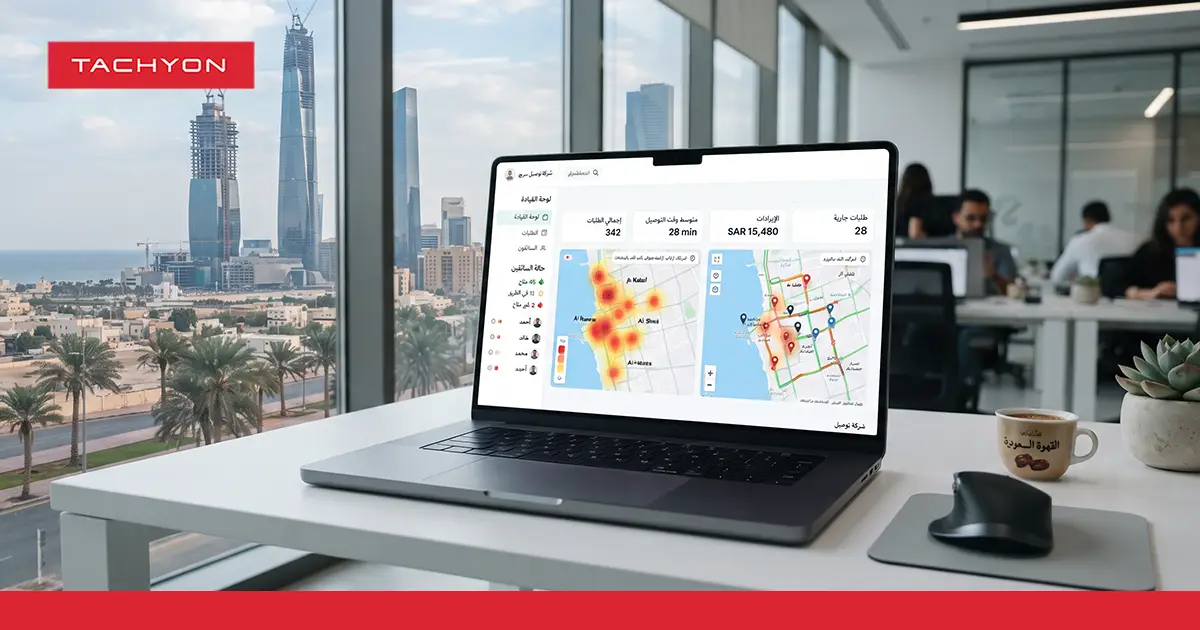
What Real-Time Visibility Does an On-Demand Delivery Operation Need?
Real-time visibility is more than watching driver icons on a map. A business must be able to answer:
- Which orders will become late?
- Which location is overloaded?
- Which drivers can take another task?
- Which orders are waiting for pickup?
- Which delivery requires manual intervention now?
Where Do On-Demand Delivery Operations Break Under Scale?
- Manual Order Allocation: Dispatchers cannot manually evaluate every driver, route, and priority fast enough.
- Inventory Mismatch: Accepting orders that selected locations cannot fulfill.
- Wrong Fulfillment Point: Routing to a close but operationally overloaded location.
- Slow Picking & Pickup Waiting: Drivers waste productive time waiting for warehouse or store preparation.
- Static Routes: Existing plans fail to adapt when new orders arrive.
- Disconnected Systems: OMS, warehouse, and delivery teams work from conflicting records.
- Weak Exception Management: Problems are discovered only after the customer complains.
- No Unit Economics: Improving delivery speed without knowing whether each order remains profitable.
Which KPIs Show Whether On-Demand Delivery Is Actually Working?
- Order-to-Dispatch Time: How quickly operations move from confirmed demand to driver assignment.
- Order-to-Door Time: The complete journey from order creation to final delivery.
- Fulfillment Time: Separates warehouse delays (picking/packing) from delivery delays.
- On-Time Delivery Rate: Success in meeting promised delivery windows.
- Driver Utilization & Orders per Driver Hour: Measures delivery productivity and capacity usage.
- Pickup Waiting Time: Reveals misalignment between fulfillment and driver arrival.
- Cost & Revenue per Delivery: Evaluates speed alongside delivery economics.
- Exception & Cancellation Rates: Measures deliveries requiring manual intervention or failing entirely.
- ETA Accuracy: Compares the expected arrival time with actual completion.
A logistics analytics software layer can bring order, fulfillment, driver, delivery, cost, and exception data into common dashboards and KPIs, turning operational logistics data into management visibility.
How Tachyon Supports On-Demand and Q-Commerce Delivery
- Keep Incoming Demand Organized: TachyonOMS centralizes orders so teams maintain clear visibility into incoming demand, order status, and fulfillment routing.
- Keep Fulfillment Ready for Fast Delivery: Tachyon’s warehouse capabilities support structured fulfillment, connecting inventory workflows with the wider logistics operation.
- Execute Dynamic Last-Mile Operations: TachyonBullet handles real-time dispatch, driver tracking, route optimization, and last-mile execution without needing spreadsheets or messaging apps.
- Keep Operations Connected Through APIs: Tachyon integrates logistics workflows with existing operational systems to prevent duplicate data entry.
- Use Delivery Data to Improve Decisions: TachyonInsights provides dashboards and analytical reporting to help management improve future capacity and delivery decisions.
Build a Faster On-Demand Delivery Operation With Tachyon
Reliable instant delivery depends on coordinating order capture, fulfillment readiness, available delivery capacity, dynamic routes, tracking, customer communication, exceptions, and performance measurement.
For e-commerce, retail, grocery, food distribution, and logistics businesses in Saudi Arabia, these connections are critical for meeting shorter delivery windows while maintaining sustainable economics. Use Tachyon to connect orders, fulfillment, and on-demand last-mile execution instead of managing each stage through separate workflows.
Request a Tachyon demo to explore a connected delivery environment designed for faster, more scalable, and data-driven logistics operations.
Frequently Asked Questions About On-Demand Delivery Platforms
What Is an On-Demand Delivery Platform?
An on-demand delivery platform is software that coordinates incoming orders, fulfillment locations, available delivery capacity, dispatch, routing, tracking, and delivery confirmation in real time so businesses can respond to delivery requests shortly after they are placed.
How Does On-Demand Delivery Software Work?
It receives order data, identifies the best fulfillment location, checks available delivery capacity, assigns a driver, plans or adjusts the route, tracks execution, updates the customer, and records delivery completion.
What Is the Difference Between On-Demand and Scheduled Delivery?
On-demand delivery responds to orders continuously as they arrive, relying heavily on real-time capacity and dynamic assignment. Scheduled delivery allows operations teams time to plan routes, drivers, and delivery windows in advance.
Is an Instant Delivery Platform the Same as Q-Commerce?
Not exactly. An instant delivery platform supports rapid delivery across several industries. Q-commerce is a specific operating model combining nearby inventory, very fast fulfillment, hyperlocal delivery, and ultra-short order-to-door expectations.
How Does Q-Commerce Delivery Work?
An order is routed to a nearby store, dark store, or micro-fulfillment point. The order is picked rapidly, delivery capacity is assigned, the route is optimized, and the customer receives real-time updates as the driver executes the hyperlocal route.
How Does an On-Demand Platform Assign Drivers?
The platform evaluates driver location, availability, existing workload, vehicle capacity, pickup points, current routes, traffic, and delivery windows before selecting the most suitable resource.
Can On-Demand Delivery Software Handle Multiple Fulfillment Locations?
Yes. Multi-location operations can route orders between warehouses, dark stores, or retail branches. Allocation logic considers inventory, fulfillment capacity, operating hours, and available delivery resources alongside distance.
How Does Real-Time Route Optimization Work for Instant Delivery?
New orders and changing conditions are evaluated against active routes. The platform recalculates assignments and stop sequences based on real-time location, traffic, driver workload, and delivery windows, inserting new orders directly into active routes.
Can Businesses Use Both Owned and Third-Party Drivers?
Yes. A hybrid delivery model combines internal drivers with external delivery partners. The system maintains centralized visibility into assignments, tracking, performance, and exceptions across both capacity sources.
What KPIs Should an On-Demand Delivery Platform Track?
Key measures include order-to-door time, fulfillment time, on-time delivery, driver utilization, orders per driver hour, pickup waiting time, cost per delivery, SLA breaches, ETA accuracy, and exception rate.
How Can Businesses Reduce the Cost of Instant Delivery?
Businesses can improve delivery economics by increasing order density, reducing pickup waiting times, optimizing routes, limiting empty movement, improving first-attempt success, and measuring cost per delivery alongside customer service levels.
Can an On-Demand Delivery Platform Integrate With OMS and WMS?
Yes. Connecting order management, inventory, fulfillment, dispatch, and tracking reduces duplicate data entry and ensures the delivery layer has reliable information about order existence, inventory availability, and pickup readiness.
