
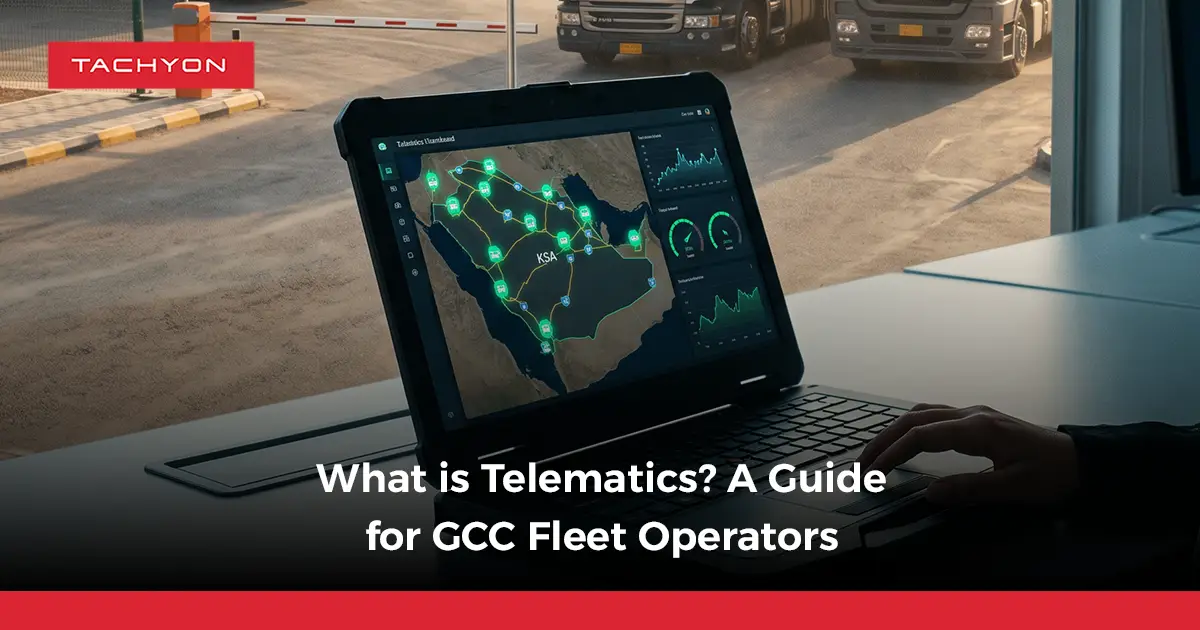
To fully grasp what is telematics, one must look beyond basic location monitoring. It represents an advanced technological ecosystem that captures, encrypts, and transmits live vehicular metrics across vast distances. This architecture evaluates mechanical health, driver habits, and environmental conditions, relaying insights to cloud dashboards. For regional operators, it guarantees regulatory alignment, minimizes operational waste, and continuously empowers decision-makers with instantaneous, data-backed operational intelligence.
Understanding Telematics in Fleet Operations
The true telematics meaning revolves around a closed-loop digital infrastructure that broadcasts live vehicle diagnostics to remote servers, converting a complex Glossary of mechanical inputs into actionable intelligence.How the Technology Operates
- Data Harvesting: A compact hardware unit links directly with the vehicle’s OBD-II or CAN-Bus ports, instantly pulling dynamic metrics such as engine temperature, braking intensity, and active fuel consumption.
- Satellite Positioning: Built-in antennas utilize satellite networks to determine precise geographical positioning, directional movement, and exact travel speeds.
- Wireless Broadcasting: Relying on embedded 4G/5G SIM technology, the hardware encrypts and streams this massive data payload across cellular networks without delay.
- Algorithmic Processing: Cloud-based software analyzes the incoming streams via artificial intelligence to populate management dashboards while instantly forwarding regulatory metrics to state portals like “Wassal”.

Key Components of a Vehicle Telematics System
A functional vehicle telematics system requires a seamless blend of resilient physical hardware and sophisticated cloud-based analytics platforms.Essential System Infrastructure
- Telematics Control Unit (TCU): The primary hidden module equipped with GPS receivers and multi-axis accelerometers to record physical driving patterns, including sudden impacts or aggressive cornering.
- CAN-Bus Integration: The direct wired connection to the truck’s internal computer network, retrieving vital live diagnostics such as engine fault codes, tire pressure, and actual fuel levels.
- Cellular Connectivity: Employs regional 4G/5G networks to ensure continuous, encrypted wireless broadcasting, with internal memory retaining the logs during temporary signal losses to prevent data gaps.
- Ancillary Sensors: External add-ons like BLE temperature monitors for pharmaceutical transport, electronic door seals, and AI-powered dashcams that detect driver fatigue.
- Cloud Software Interfaces: The central intelligence hub functioning as a comprehensive Fleet Management System, projecting interactive maps and driver analytics, alongside API bridges that feed compliance registries automatically.
How Fleet Telematics Improves Fleet Operations
Integrating fleet telematics completely redefines logistical workflows, maximizing your Fleet Management ROI by transforming constant data streams into strategic, cost-saving actions.Operational Advancements
- Fuel and Cost Optimization: Tracks unnecessary engine idling and dynamically reroutes drivers away from heavy traffic, effectively cutting fuel expenditures by nearly 20%.
- Proactive Maintenance: Uses live engine fault codes to trigger maintenance alerts before critical failures occur, scheduling repairs based on exact odometer readings rather than arbitrary calendars.
- Safety Enhancements: Grades drivers by monitoring hazardous habits like harsh braking or speeding, utilizing intelligent cabin cameras to issue immediate audio warnings for distracted driving.
- Client Satisfaction: Generates highly accurate arrival estimations based on live tracking, while geofencing restricts vehicle movement to authorized zones and designated working hours.
- Temperature Compliance: Protects sensitive food and medical cargo by continuously logging thermal variations, instantly alerting managers to any deviations from SFDA-approved limits.
- Regulatory Automation: Continuously syncs live movement logs and driving shifts with the mandatory “Wassal” registry, securing legal compliance and simplifying license renewals.
Telematics vs GPS: What Is the Difference?
When evaluating telematics vs gps, it becomes evident that GPS is simply one foundational layer within a much broader analytical framework.Global Positioning System (GPS)
- Primary Function: Communicates strictly with satellite constellations to calculate a unit’s location on the globe.
- Available Metrics: Delivers fundamental spatial coordinates, general direction, and estimated travel speed.
- Typical Application: Widely adopted for consumer navigation applications and rudimentary GPS Fleet Tracking.
The Telematics Ecosystem
- Primary Function: Combines satellite mapping with high-speed cellular telecommunications and deep mechanical vehicle integrations.
- Available Metrics: Scrutinizes driving habits, engine diagnostics, precise fuel burn rates, and cargo environmental conditions.
- Typical Application: Indispensable for commercial supply chain management, offering critical business intelligence and mandatory government synchronization.
Benefits of Telematics for GCC Fleet Operators
- Government Compliance: Automatically satisfies strict regional tracking mandates, directly feeding databases like Saudi Arabia’s “Wassal” or the UAE’s “Asal”.
- Extreme Weather Resilience: Monitors coolant temperatures and engine strain in real-time, preventing catastrophic mechanical failures during intense Gulf summers.
- Cold Chain Integrity: Secures cross-border perishable shipments by maintaining rigorous, verifiable climate logs that satisfy SFDA and regional health authorities.
- Fuel Efficiency: Drastically reduces operational overhead by monitoring AC-induced engine idling and plotting the most fuel-efficient transit corridors.
- Border Transit Acceleration: Harmonizes seamlessly with international TIR customs protocols, expediting vehicle clearance at major GCC land borders.
- Accident Prevention: Employs AI visual analysis to correct dangerous driving behaviors instantly, safeguarding long-haul transport across expansive desert highways.
- Mileage-Based Servicing: Replaces outdated calendar maintenance with intelligent service schedules and Fleet Right Sizing strategies triggered by actual vehicle wear and tear.
- Cargo Security: Deploys strict geofencing perimeters and door-opening sensors to immediately flag unauthorized access or route deviations.
Key Telematics Trends in the GCC
The most prominent telematics trends gcc are currently reshaping regional logistics, shifting from basic tracking to highly predictive supply chain orchestration.- AI-Enhanced Dashcams: In-cabin cameras now analyze facial cues to warn drivers of microsleeps, lowering accident rates by up to 70%.
- Mandatory API Integration: Regulatory bodies are enforcing strict, non-negotiable API links between private dispatch software and sovereign traffic monitoring platforms.
- Factory-Fitted Hardware: Heavy commercial vehicle brands are abandoning aftermarket plug-ins, rolling out trucks with fully embedded, native diagnostic trackers.
- Electric Vehicle Logistics: Platforms are evolving to monitor battery degradation, live charge metrics, and optimal charging stop locations for zero-emission fleets.
- Machine Learning Diagnostics: Advanced algorithms process CAN-Bus data to accurately predict impending brake or battery failures before they cause highway breakdowns.
- Wireless IoT Sensors: Leveraging BLE technology to create seamless, cable-free monitoring networks inside refrigerated trailers for flawless cross-border transit.
Scale Operations with Tachyon
Mastering modern supply chains demands a unified digital approach, Tachyon, an AI-Powered Digital Logistics Platform in Saudi Arabia, consolidates your entire operation into one intuitive dashboard. By harmonizing an advanced Transportation Management System (TMS), Warehouse Management System (WMS), and intelligent Last-Mile Delivery (Bullet) with live vehicle tracking, Tachyon translates complex metrics into profitable outcomes.Automate your workflows, ensure flawless compliance, and reduce overhead with our comprehensive cloud logistics platform today.
